Table of Contents
Xtauh relations with other species
There are two other sapient species on avishraa; although the xtauh have at one time or another come into contact with both, they have had far more experience with the takmar than the orghysh. Their relations with each are described below.
Takmar
Broadly speaking, the takmar and the xtauh are not prone to good relations. The primary driver of this is competition for land and resources; for well over a hundred cycles, takmar have steadily displaced xtauh from the river valleys of the southern brightness, relegating them to the desert and other marginal areas, and in many cases only the great environmental flexibility of the xtauh has prevented them from being driven extinct in those areas; they can survive on far less water than takmar can, and as a result the latter find it difficult to traverse large parts of the arid landscape.
Their mutual animosity has other components, however. The xtauh are the close evolutionary cousins of the takmar. Though neither species would be particularly inclined to acknowledge their similarities, there are nonetheless a good many of them. In a sense, however, it is the similarities that have contributed to the two species' fraught history with each other. They have differences in their appearance, psychology, and habits that while not completely alien are, perhaps, worse, in that they are familiar enough to cause a member of one species to think they understand what is happening, while being different enough to prove them wrong.
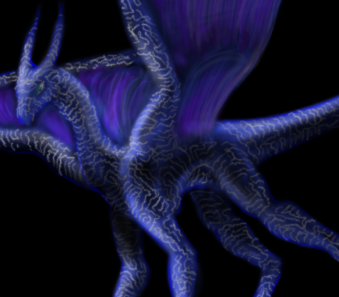
At the most basic level, the misunderstandings begin with a difference in their very bodies. Both takmar and xtauh rely heavily on their antennae for emotional expression and nuance; but the takma's antennae are swept backward from the head, relatively straight, while those of the xtauh are much longer, and extend sideways from the head, curling downward. While the way each species positions its antennae in various moods is actually analogous to that of the other - each species uses the same muscles to move them when, for example, alert - the results are visually different enough that the underlying similarities are not obvious to the untrained observer. To a xtauh, takmar generally have a perpetually gloomy, uninterested look, as if depressed or otherwise rendered emotionally insensible. While those with long experience with the other species can learn to recognize their emotional signals for what they are, there are regrettably few opportunities for it.
(Regardless, though each species looks, at best, unusual to the other, their body shapes are similar enough that, perhaps inevitably, sexual liaisons do occur. Though the size differences may cause some difficulty, they are broadly speaking physically compatible with each other. The two species also remain genetically close enough that interbreeding is possible, albeit risky.)
The two species also have genuine differences in their underlying attitudes toward society. Takmar are more prone to cooperate between themselves and to set aside competing interests for greater goals; they are fonder of hierarchies, if only for the prospect of advancement. Many of them are willing to settle for differences of status, provided they can extract some measure of benefit from it. While it has many downsides, this approach to things facilitates the development of large-scale, unified civilizations. Xtauh, for their part, are more individualistic, and more intensely clannish; they do not easily submit to the wills of most others. Their approaches to family and other forms of group identity are also different; takmar tend to be more inclusive in their groups, to have more extended definitions of those groups, and to be more willing to 'adopt' outsiders; xtauh societies tend to be more stringent, forming tightly-knit groups capable of close cooperation, but distinguishing clearly between insiders and outsiders, the latter of whose problems are secondary.
In short, the takmar often appear to the xtauh to be maudlin, submissive, insufficiently independent or respectful of independence, and prone to extremes of caution and incaution, generosity and acquisitiveness.
Raiding by xtauh upon takma settlements in the Brightness is common, and many takma cities in turn conduct operations against the xtauh, killing or enslaving as many as they can find. The situation is one of perpetual bloody stalemate, as the takmar are limited in their reach into the desert, while the xtauh have neither the numbers nor the organization to overpower or drive out the takmar for long periods.
Throughout much of the xtauh-occupied southern Brightness, it does not pay for takmar to travel or found settlements without effective defensive measures; unless they have won or bought to forbearance of local xtauh, they are likely to be attacked and killed, and the xtauh will not tolerate takmar within their settlements except, rarely, as slaves.
More recently, the rise of the great_illumination among the takmar of the eastern Brightness has opened a new path for interspecies cooperation. The universality of the movement's mission inclines it to accept the personhood, and especially the devotion, of xtauh as well as takma, and its antihierarchical undercurrents appeal greatly to xtauh who have no interest in the autocratic pronouncements of more organized religions. The region dominated by the Illumination is one of the few where the two species coexist in close proximity, and the religion is possibly the only one founded by takmar to have gained significant numbers of xtauh adherents. Because this area also contains most of the Brightness' ports, xtauh can sometimes be found living relatively peacefully in places like Ǣdyihòzh that can be reached by ship.
Orghysh
The orghysh are relatives of both the takmar and the xtauh, though their ancestors diverged far further back. Native to the Sea of Grass, the bulk of the species subsists on hunting and gathering in nomadic bands, limited to tools of stone, bone, and wood. They are remembered in xtauh legends, but direct contact has been mostly cut off.
The orghysh were simultaneously more and less inscrutable to the xtauh than are the takmar: more, since their body language has fewer parallels from which to extrapolate any understanding; yet less, since, unlike both takmar and xtauh, the orghysh are far less prone to muffle their empathic output. The complex but unshielded emnotional profiles they present remind the xtauh of those produced by children.
The Sea of Grass is a favorable habitat for the xtauh, and in prehistory, before the migration of takma populations into the region, xtauh and orghysh bands competed for prey and favorable territories; both species were at a comparable technological level and had no distinct advantages in combat, and so relations between them were beset by constant low-level, localized conflicts interspersed with equally low-level, local trading links. The arrival of the less well-adapted, but more technologically advanced and socially cohesive, takmar drove the xtauh northward toward others of their kind and away from the orghysh.
While contact between xtauh and orghysh is not unheard of, it remains rare, and its primary effect has been the spread throughout the southwestern Brightness of myths and stories about hulking, two-legged beings with tiny, useless wings, infantile in thought but destructive in their tantrums.