Table of Contents
Xtauh body
Parts
Face
Olenor
Wings
Tail
Sexual dimorphism
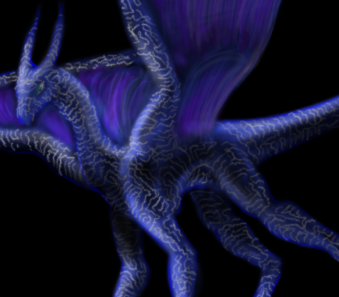
Xtauh exhibit several points of morphological variance between males and females, perhaps the most consistently noticed of which is size. Although young xtauh of the same age remain in roughly the same size range through most of their early lives, beginning in late childhood the average size of females increases faster than that of males. By adulthood, the average female masses 60 kg (weighing roughly 52 kgf in Avishraan gravity), is 1.9 meters (6.2 ft) from nose to tail, and has a wingspan of 4 meters (13.1 ft). By contrast, the average male masses 38 kg (roughly 33 kgf local), and is 1.75 meters (5.75 ft) long with a 3.5-meter (11.5 ft) wingspan.
From these figures it can also be seen that males tend to have a lower mass and greater wingspan relative to their length than females do. This reflects a difference in lifestyle specialization between the sexes, and is part of a collection of related dimorphic traits. Males are typically faster and more agile fliers, and aside from their size and wingspan, have more wiry builds overall but more developed flight muscles in the chest. Partially due to this fact, males have more difficulty with bipedal locomotion, as their center of gravity is further forward in their body and requires more effort to lift. Females, conversely, are weaker fliers; though they are entirely capable of flight, their heavier, more muscular builds do not permit them the same speed or agility as the males in the air. Nonetheless, they are surprisingly formidable on the ground, with wider hips and thicker thighs providing them a more rearward center of gravity and allowing them to switch quickly between quadrupedal motion and paws-freed bipedal motion with relative ease.
Although males and females have approximately the same possible range of possible colors, their distribution on the body is different, with males tending to have simpler color schemes relying on shading of a single color, with patterns of shade contrast on the dorsal wing surfaces, and females more often having two (or rarely more) different colors, dark stripes on their backs, and a wide variety of possible patterns on their heads, necks, and lower bodies.