Table of Contents
Avishraa
Avishraa is the largest and furthest out of the three major moons of the gas giant Kastun, in the Mikurmiya system. Like Earth, Avishraa is habitable, with a nitrogen-oxygen atmosphere, oceans, continents, and rich biospheres; but in many ways, such as day length and climate, is very different. It is the central location and namesake of the Avishraan setting, particularly the continent of Sekhaa, and is the home of three known sapient species: the takmar, the xtauh, and the orghysh.
…The Two Highest were moved by the wish of Their child, and in the joining of Their forepaws and of Their voices They moved to fulfill it.
At Their bidding did a great pillar rise from the bottomless depths of the Void where Uvuun dwelt, and it was made of metal that burned hot, that none would attack it. And They sculpted a great bowl of the clay of Their thoughts, and placed it upside down upon its summit, and it was fired into hard stone by its heat. Then They called to them all Their children, and bade them turn to it.
'Behold,' said They, 'We have fashioned a place for Life to dwell, as Our youngest begged of Us. In all other places in the Void, you may contend with one another as you please, but here, and here only, your struggles must be restrained. Storm may beat back Fire, but not overcome it, and the same may be said of Rock and Wind, Sea and Land. This shall be, so that none has the strength to overcome the living growing things that Our youngest has placed there, and they shall thrive in spite of you and those you kill; and for this it shall be called Avishraa, the Abode of Life. This is Our command; let it not be gainsaid.'
And with This, they withdrew, and Their children took possession of the world that was made, each filling it with such things as the others would allow…
from the Imperial creation myth
Numerical characteristics
Orbital
These figures describe the orbit of Avishraa around Kastun, rather than that of Kastun around Mikurmiya.
- Periapsis: 2605100 km
- Apoapsis: 2608800 km
- Eccentricity: 0.0007
- Orbital period: 45.816 Earth days
- Inclination: 0.1863° to Kastun's equator
Physical
- Mean radius: 5630 km (88.37% Earth)
- Equatorial radius: 5631 km
- Polar radius: 5629 km
- Flattening: 0.00036
- Surface area: 3.985 x 10⁸ km2 (76.36% Earth)
- Volume: 7.4764 x 10¹¹ km3 (69.02% Earth)
- Mass: 4.0347 x 1027 g (67.56% Earth)
- Mean density: 5.3966 g/cm3 (97.87% Earth)
- Mean surface gravity: 8.495 m/s2 (86.62% Earth)
- Escape velocity: 9.778 km/s (87.41% Earth)
- Sidereal rotation period: 45.816 Earth days
- Solar rotation period: 54.709 Earth days
- Axial tilt: 0.3439° from orbital plane
Orbit and rotation
Avishraa is the furthest out of three major moons of the gas giant Kastun. The orbit of Kastun itself around the sun, Mikurmiya, has a semi-major axis of slightly over 124 million kilometers, placing it and all its moons within the habitable zone of the sun. Avishraa itself orbits the Saturn-like body at a distance of approximately 2.6 million kilometers, a distance that places it within Kastun's magnetopause - barely - and therefore protected from cosmic radiation, but far enough from the planet that it does not lie within the radiation belts that surround it. Avishraa therefore occupies a fortunate niche: at the right distance from the sun to be neither too cold nor too hot, and at the right distance from its planet to be protected from radiation.
Avishraa is tidally locked to Kastun: its period of rotation is the same as its orbital period, and it always presents the same face to Kastun. Kastun (which, depending on Avishraa's position in its orbit, appears between 2.3 and 2.7 times as wide as the moon does on Earth) therefore moves very little in the sky as viewed from any given point on the surface, and is a reliable beacon for navigation on the near side, weather permitting.
Avishraa has neither a strong axial tilt with respect to its orbital plane nor a strong orbital inclination with respect to the Kastun's equator, and the axial tilt of Kastun itself is quite small; so that the effective tilt of Avishraa with respect to the sun is essentially never much higher than 2.5°. As a result, seasonal variation in the Earthly sense is for practical purposes nil - certainly beyond the ability of its native sapients to measure - and such effects as might be apparent are dwarfed by those caused by Avishraa's rotation. (In passing, it should be noted that - due both to this low tilt and to Kastun's large angular diameter compared with Mikurmiya, eclipses are a frequent occurrence.)
Composition and geology
Avishraa has an approximately earthlike composition, with a silicate crust and a nickel-iron core, and has only a slightly lower density than Earth. Despite being only 69% the size of Earth by volume, Avishraa is large enough to have retained a molten core into the present day, particularly with the aid of tidal friction between Avishraa, Kastun, and the other major moons. This internal heat remains sufficient to drive plate tectonics in the crust; as a result, Avishraa is a geologically active world, and experiences volcanism, earthquakes, subduction, and seafloor spreading, among other processes.
Geography
(See also places)
The surface of Avishraa is mostly (70-80%) covered by saltwater oceans. Although minor landmasses are scattered across the surface, most of the land area is concentrated in four or five continents - depending on how closely some accumulations of small land masses must be clustered to define them as 'continents'. All three known sapient species on Avishraa live on the continent of Sekhaa and its associated islands, which all lie approximately in the center of the Kastun-facing side of Avishraa; it is only in recent years that explorers have become aware of the existence of the continents of Enarri and Talmat, and knowledge of them is neither extensive nor widely available.
Atmosphere and hydrosphere
The atmosphere has about 90% of the pressure of Earth's but has approximately the same nitrogen-oxygen composition.
Avishraa's slow rotation has two major implications for the dynamics of both the atmosphere and the hydrosphere. The first is that the Coriolis force is, if not zero, then so weak as to make little difference. The second is that, because the numbers of latitudinal atmospheric circulation cells grow with faster rotation and diminish with slower rotation, Avishraa effective possesses only two hemisphere-wide Hadley cells, whose surface winds tend to blow from either pole toward the equator, and to drive humidity and surface waters in the same general direction. For the atmosphere, such deviation as there is from this pattern is driven mainly by topography (ex. orographic lift) and by the temperature differentials between portions of the surface (particularly, but not exclusively, between land and water and between the day and night sides). The hydrosphere is likewise affected by topography and the need to flow around continents, but also by temperature and salinity variation at different depths.
Climate
The strong pole-to-equator orientation of global wind patterns dictates a general pattern of climates. As surface winds move toward the equator, they warm up, and also pick up moisture as they travel over water. Reaching the equator, the winds meet and rise, and release large amounts of precipitation as they do so; drying and cooling with altitude and latitude, the air then returns to the poles, where it descends once more as a very cold, dry mass. Therefore, at the surface, there is an overall alignment of temperature and precipitation: the higher the latitude and closer to the poles, the lower both temperature and precipitation get, and were Avishraa's surface flat - or covered entirely by uninterrupted water - this pattern might remain unbroken.
But because neither is the case, there are areas where the pattern does not hold. High-altitude areas are usually colder than their surrounding lowlands. Where high elevations rise as barriers to surface winds, those winds, forced to rise and cool and shed their moisture, will cause precipitation on the poleward slopes (and tend to cast warm, dry rain shadows toward the equator; a not-dissimilar mechanism tends to make the poleward coasts of continents moister than their equatorward interiors, particularly long distances from said coasts. Therefore, although Avishraa is dominated by a cline between hot/moist and cold/dry climates, there are also regions where cold/moist and hot/dry combinations are found.
Because the length of Avishraa's day is effectively 54.7 Earth days, it causes variations in climate that resemble Earth's seasons almost as much as its day-night cycle. During the day - particularly late in the day, when the cumulative heating effect is strongest - a given face of Avishraa's surface will exhibit global wind patterns that are strongly pole-to-equator. As evening arrives and turns to night, the winds increasingly turn toward the west (though rarely due west), as air from the warm daytime side of the moon moves across the evening terminator toward the cooler night side (helping to moderate nightly temperatures). These winds tend to bring warm fronts and an increased chance of rainfall through the first half of the night.
As the night moves into its second half, the pole-equator winds pattern returns, albeit weaker than during the day and with considerable atmospheric instability (and attendant chance of storms), especially on and around land. Toward sunrise, winds trend toward the east, although more briefly and weakly than the evening winds, before returning to a largely pole-equator pattern through the morning.
A brief summary of the above might state that Avishraa is dominated by rainforests near the equator, shading into forests, grasslands, and then tundra toward the poles, with desert in low-latitude continental interiors and the anti-poleward sides of mountain ranges, and taiga on high-latitude poleward coasts and the poleward slopes of mountain ranges.
The revolution rate and low and varying effective axial tilt of Avishraa make the formation of permanent icecaps difficult, since it means that there is rarely enough space or time where the sun is out of the sky for reliably long enough periods. While areas of permafrost and ground ice exist on polar landmasses, most surface ice is not stable year round except in mountainous regions, either atop mountains (where the cold of high altitudes prevents the sunlight from melting the ice), or in deep valleys (where surrounding mountains prevent the low-angled sunlight from reaching the ground for much of the year).
Fauna and flora
As a living world, Avishraa harbors millions of species.
Of its flora, there are analogues of many of Earth's basic plant types: grasses, shrubs, trees, and so on. An economically important plant in the lowlands of Sekhaa is wet-grain, a semi-aquatic plant that bears some similarities to rice.
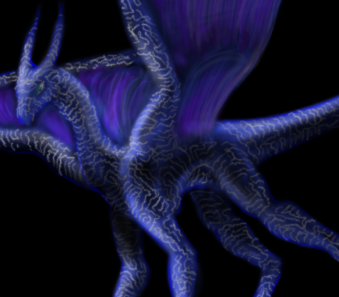
One of the major clades of fauna on Avishraa are the hexapods, so called because their ancestors had six limbs; all higher animals on Avishraa are members of this clade, although some have since experienced the modification or loss of one or more pairs of limbs. One group, the draconiforms, developed 6.5 million cycles ago from small, active arboreal hexapods whose tree-hopping lifestyle encouraged the development of their anterior limbs into gliding wings. Over time, they became a widely spread and diversified clade, aided by a number of mass extinctions that cleared out competitors.
One of the subclades that eventually developed, the takmids, were grassland-dwelling predators, fond of fish but with the flexibility to hunt terrestrial animals as well. All three sapient species on Avishraa are takmids: one branch, the dvidalins, remained in what is now the Seas of Grass and resulted in the orghysh; the other, including the pre-takmar, inhabited what were then grasslands on the other side of the Iceteeth. As the latter region dried out and became the desert now known as the Brightness, the pre-takmar diverged into the two remaining sapient species: the takmar and the xtauh.
Most large land animals today are of draconiform lineage, but some cold-adapted large species - and many smaller species - are the hexapod equivalent of mammals, and bear fur rather than scales, though they generally do not give milk and feed their young with pre-chewed or regurgitated food. A number of domesticated animals fall into this category, including the axtin, which occupies a niche somewhat like that of the terrestrial goat.
Geopolitical units
(See also communities)