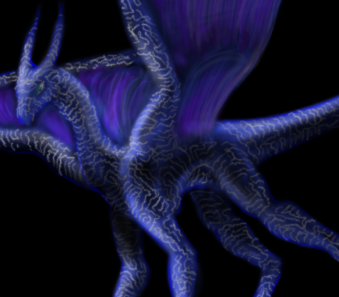
Partly to help himself articulate himself on certain topics, partly to see if anyone at all was interested, and partly just because he had a social platform with an audience that was plural but probably not too big as to induce stage fright, Shyriath began posting on schlaugh a series called the Avishraa Tirades. In the interests of having copies under his own control and on the same site he's busy moving things to, he has made the Tirades available on this wiki.
Other notes: “The city of Aedyihozh (not the orthography I use, but I don't know how to type it on mobile) is the center of a small maritime empire. The original town was built around the edge of the bottom of a sinkhole connected to the sea, as an attempt by another city to have a hidden harbor in a strategic location; it means something like 'Well Town': adyin 'a pit used to store something'; hozh 'town' (cognate to Imperial kar 'a settlement purposely founded, as opposed to one that grew in place over time'.)
hozh, as you might guess, is a common suffix within the same cultural area. The other Abethine city-states don't have much trouble pronouncing it but consider the city to be culturally unpleasant and a political upstart, so it's not unusual for it to be nicknamed Inahozh 'Hole City'.
Because it's a relatively new city, the Imperial-descended languages of the interior tended to just adapt the name to their own pronunciations. In the central stretches of the Sahvarr valley this comes out as something like Aadihash.”
“The Imperial religion, which in one form or another is the dominant belief system of the takma species, holds that Uvuun, a dark, cold deity who was the first thing created and who dwells in the abyssal seas, hungers to devour everything. The bodies of the dead and anything that is destroyed are said to go to Him, but at the end of the world He will come forth and eat all creation. The prevailing opinion is that there is nothing that can be done about this except to anger Him as little as possible in the meantime.
The Seekers of the Depths, however, see it a bit differently. While everyone assumes that the end of the world is going to come someday, the Seekers are a somewhat apocalyptic group who believe it's going to come sooner rather than later if nothing is done. Fortunately, they say, something can be done. The hunger of Uvuun cannot be entirely quenched, but the Seekers believe it can be lessened if, instead of merely waiting for things to come to Him, He is fed regularly by loyal servants. The Seekers, therefore, see it as their mission to send their master feasts through death and destruction. Depending on the skill, inclination, and organization of the cultists, this can run the gamut from vandalism and random murder, to organized riots and revolts, to assassinations or vigilante justice.
The Seekers have no central organization, but are made up of autonomous groups called courts. These usually begin existence as one of the nomadic bands of unattached males that takma societies generate, and like other such bands, travel from place to place, renewing their membership by recruiting young males leaving their mothers' households. These boys, being inexperienced and often eager for a sense of belonging, are vulnerable to being lured into the cult's practices and ideology. Courts, for obvious reasons, cannot openly advertise their true nature, so while many of them have become skilled at finding candidates that are likely to be willing, there is inevitably a certain amount of wastage, as some new recruits start having second thoughts and attempt to leave the group.
The Seekers, as the above implies, are usually male. Sometimes, however, they are able to draw in female members, usually those young, low in status, and disgruntled with society. Either several males will amiably depart a court and settle down with a suitable wife, or a court will convince one to leave with them and build a home in the wilderness for her. In either case, the female accepts the ideology of the cult in exchange for a feeling of importance and family structure. Those who are willing to leave with a court, in particular, essentially become the focus of an entire small community, and the males who do not actually marry them often treat them with extravagant courtesy. Children produced are usually raised as Seekers, although the more enthusiastic Seekers may offer at least some of them to Uvuun.
In the absence of a female, the more experienced and respected male members of a court tend to become leaders - majordomos, in internal parlance - but general agreement, and they function collectively as a kind of steering committee for day-to-day leadership, and maintain the religious functions of the group. If a female joins, she usually assumes the religious role as a priestess, and presides over the majordomos, some or all of whom tend to become her husbands. That said, courts tend to have a fairly communal flavor to their governance, trying to have consensus over major decisions. In the event that a faction develops with irreconcilable differences, they will generally be allowed to split off as a separate court rather than allow disharmony to continue.
When the time comes to make an offering to Uvuun, it will be preceded by a ritual in which the majordomos or the priestess, with the Court assembled, speaks to Him and offers Him a “feast”. Then, those who are chosen to kill or destroy are sent out. As avoiding attention from the authorities is a paramount consideration, they operate singly or in small groups, unless in a situation where any investigation is unlikely to be swift (an isolated farmstead, for example). Larger groups may sometimes be involved if action on a larger scale is required - say, organizing a revolt - but even here is employed only as needed, and the involvement of the Seekers is usually to be hidden even from its co-conspirators. Seekers who successfully complete their missions then return to the court, preferably with proof of their efforts; those who fail are expected not to return until they succeed, even if this means sacrificing themselves. Should enough Seekers return to the court, a second ritual is performed, in which the feast is symbolically presented to Uvuun on platters and in bowls. Uvuun Himself is not always considered to be physically present, but in those courts that take such a stance, He is usually represented with a matte black stone, often a lump of bituminous coal.
The Seekers of the Depths are almost universally regarded with distaste, but their precise relationship with society varies from place to place, or more commonly from court to court. Those courts with a less organized bent often appear, for those not familiar with their actual beliefs, to behave similarly to bandits or vandals, particularly if they appear to profit from their victims (which they often do). Depending on whether destruction of property or actual murder is involved, they may be considered either a nuisance or common criminals. Those involved with social unrest are viewed more seriously - inconveniencing commoners is one thing, but going against the established order is quite another.
Some courts of a sophisticated bent, however, have managed to acquire a kind of specialist niche in society, functioning as the equivalent of an assassin's guild - their targets are arranged by contract rather than at their own discretion. Though rarely legal in any formal sense, the political realities of their host cities may prevent them from being actively prosecuted.”
“Shaking your head is generally considered rude among takma during a conversation; if you don't keep your face pointed toward the other person, it suggests inattentiveness or boredom with what they're saying.”
“In the event of a sudden Ǣdyihòzhis collapse, the other city-states turn on each other while trying to carve up the remnants, particularly the Ǣdyihòzhis system of control over the Giant's Gap that separates the Inner and Outer Seas. Whoever wins that particular piece of real estate could plausibly be in a really good position to found themselves a new thalassocratic empire, though it will help if they're able to co-opt some of their possible rivals in the process.
The fact that the so-called Rebel Royals - disaffected potential heirs to the Ǣdyihòzhis throne - have been in exile in Palkidam may lend that city some legitimacy to its bid.”
“The ghyṑl is a very large marine animal of Avishraa found in the southern oceans. A scaly creature with gills, with the approximate shape and build of a Kronosaurus, it is renowned for its ferocity and is known to occasionally attack ships traveling the open ocean. Its tusks, nearly half a meter long, are highly prized by the seafaring Abethine states as status symbols, and those who can plausibly claim to have obtained one from a living creature are lionized.
Peirèm, an early heroine of Ǣdyihòzh and the ancestor of the city's Grand Princesses, is recorded as having been one of the few who wrested a ghyṑl tusk from its original owner. While the original tusk has apparently been lost or destroyed, a brass and silver horn was created in its likeness and serves as the badge of office of the Grand Princess.”