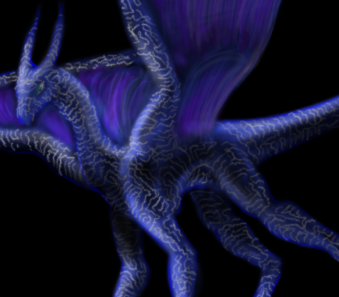
In a way, it's a little hard writing about this. The xtauh - or the takmar or orghysh, for that matter - are a whole species, not a homogenous mass, any more than humans are. They have their different cultures and languages and customs, and numerous individuals within each one, and nearly any general rule one might propose for their behavior, there's almost certain to be an exception, if not many of them, somewhere. So when I write about each the mindset and behaviors of a species as a whole, as I'll be doing here, it's important to understand that what I'm describing are generally tendencies rather than universal traits.
Also, a note about names. The first thing to understand about the xtauh is that, while that is the most neutral word the Imperial language has for referring to them, it's not what they call themselves. It originated as the name of a tribe known to the Sixfold Empire in its early days of expansion into xtauh territory, and came to be applied to the whole species; the tribe in question is now long extinct, though the word remains in cognates and borrowings (ex. [əɕːˈu] 'hard, durable'). Many xtauh in a position to be addressed by that particular form of the word, however neutral it may seem to takmar, believe it to be a slur, considering how often it is paired with insulting words.
Regardless, I use this term, rather than a native one, for two reasons. Firstly, many xtauh languages lack a word that is used purely to refer to the species as a whole, the nearest term - equivalent to “people” - also being used as a self-designation by the tribe, with everyone else being called by a variety of separate names, or, in the best cases, collectively as “other people”. The second is that the xtauh have a large number of languages with relatively few speakers each. Out of the regional trade languages, Poradric has the widest spread, but is far from universally known; the Poradric term for all xtauh collectively is hudrilao (singular hudrai, plural hudril), but most xtauh would not recognize it.
With that out of the way:
As one may have gathered from the previous Tirade, the xtauh are both individualistic and rather clannish - not necessarily in the sense of blood relations, but certainly in the more general sense of having strong feelings about in-groups and out-groups. Because an in-group can only be maintained effectively through personal relationships, the most cohesive social units are limited in size.
At the family level, female heads of families are generally able to compel submission from their dependent children and husbands, but such family relations are the only recognized, and involuntary, dominant-submissive dynamic. Otherwise, for an individual to comply with others in one's group is not considered an act of submission, but of consensus - a participation in the give-and-take that keeps the group together. This extends to the group's leaders, who are elected, acclaimed, or otherwise recognized by the group as fit for their roles; they may give orders, but will be obeyed only so long as the others recognize them as legitimate.
The combination of an emphasis on consensus and a limitation on natural group sizes has a number of consequences. The first is that xtauh social structures, on any level above the family, tend broadly to be based on popular will. While it is not unknown for leaders to be vested with near-autocratic power, this is generally only retained for as long as they are able to maintain their reputations. The second consequence is that xtauh polities of any great size are not usually single, centralized units, but alliances or confederations of smaller ones, each of which are unwilling to be in anything other than an unburdensome and equal relationship with the others.
An Earthly observer would probably classify most xtauh political entities, where they exist at all, as anything from associations to alliances to confederations, and as anywhere from anarchies to communes to direct democracies to republics or elected monarchies. The personal nature of xtauh societies, however, makes them vulnerable to individuals capable of persuading large numbers of people to regard them as leaders - because of high charisma, a perception of exceptional ability, enticing promises or policies, or some other factor. Warlords, prophets, and demagogues are common expressions of this tendency, and since xtauh governments rarely have a structure formalized by law, such leaders are capable of centralizing power with relatively little effort. While the resulting polity rarely survives the death or discrediting of its leader - dissolving, self-destructing, or simply reverting back to its previous decentralized state - while it exists, it can be terrifyingly powerful in terms of its cohesion.
The settlements of both takmar and xtauh tend to be less compact than those of humans; partly this is because of high caloric requirements - they need more food, and therefore more land, per individual to survive - and partly because of the territorial instincts of females, which results in social conflict when compressed into too small an area. However, xtauh settlements are generally even less dense than those of takmar; they are smaller and require less food, but while takmar, like humans, will readily build governments and other institutions with the authority to mediate and defuse social tensions, the xtauh generally don't.
For the next Tirade, as an illustration, we'll consider the xtauh city-state of Poradrin, the home city of the Poradric language mentioned earlier. It's one of the richest and most developed xtauh settlements, and serves as one of the best examples of what a xtauh would consider civilization.