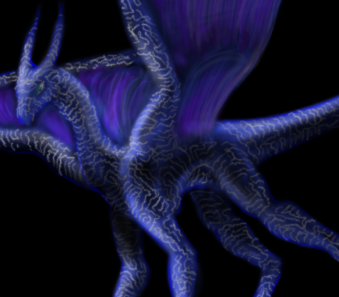
A comparison of the takmar and the xtauh is probably worth musing upon, not only as the two most prominent sophont species on Avishraa but as very closely related species. There are a number of things that make them different, which are the ones they tend to focus on when interacting with each other, but there are also an awful lot of things they have in common. Let's start with those.
Both species look pretty similar, and from a distance can be hard to tell apart unless they're right next to each other. They stand, walk, and run the same way. There are on average differences in proportions (more on that later) but they're small enough that it would not be completely weird to see a takma with a xtauh-like body, or vice-versa; there's a significant amount of overlap. They both form facial expressions in the same general fashion (but the specifics become very important; see further below). They both have antennae for hearing.
(Some explanation may be needed on that last point. The antennae of takmar and xtauh are not like insect antennae; they are, instead, long, narrow, and fleshy protuberances with hollow interiors. While not as efficient at picking up faint noises as a human ear would be, they are excellent at triangulation. Two narrow strips of muscle running the length of each antenna allows it to be moved in complicated ways, a fact that plays a heavy role in facial expression.)
In both species, females are the larger and less numerous sex. In both, they are distinguished by facial markings, which darken or lighten with social status. In both, they tend to be more territorial and hierarchical. Unmated males of both species tend to form groups and meander about the landscape. Males tend to be, among themselves, more egalitarian and social. The “nuclear family” in both species tends to be a female, one or more male mates, and children who the males all participate in caring for.
(Family and intimate social life are things that members of one species rarely get to see in the other, but are most likely to be understood and sympathized with when they do.)
Takmar and xtauh really do have a lot in common, which probably explains why they relatively frequently try to screw each other. It's not always welcome, but it happens.
But there are differences as well. The most obvious, physically, is size; xtauh are a good deal smaller than takmar, and on average less stocky and with proportionally larger wings. Xtauh lack the scale type that in takmar results in blue-green-purple coloration (pairings where the takma partner has this scale type are far less likely to result in living offspring). And, significantly, the antennae of the two species are of different shapes; those of takmar are relatively straight and backwards-swept, while those of xtauh curve out to the sides, down, and back in in loose spirals.
This last fact is one of the great contributors to the difficulty that the two species have in interacting. While the components of facial expressions involving the antennae are analogous in both species - the same muscles being used in each case for a happy expression, a surprised one, a fearful one - the differing shapes of their antennae mean that the resulting expressions are often very visually different. To the uneducated observer, which is the vast majority of them, a member of one species is likely to badly misinterpret the expression of a member of the other, if they find it comprehensible at all.
Just as profound are the differences in psychology. Takmar, like humans, are apt to form hierarchies of power and institutions and be willing to use them for advancement or protection, and, while tribal, are relatively willing to adopt others into their in-group if there is nothing actually disqualifying them.
Xtauh, however, have different attitudes toward social relations. In the first place, they are individualistic, placing high value on individual qualities, abilities, and achievements, and tend to view social structure in terms of interactions between individual people, or between groups as aggregations of individual people. Eliciting cooperation may be achieved through love or respect, or by an equitable exchange or mutual interest, but doing so simply because someone says one should is likely to attract scorn. The idea that an impersonal force - the rule of law, the dignity of an office, an institution - could command any respect of its own is, if not incomprehensible, then at least foreign.
Also, xtauh social networks tend to be tightly knit and focused but small and exclusive - most require some kind of ritual or procedure to join, and many of them have some continuing requirements or expectations to be met to remain in association with it. This is not always understood in explicit terms, but it can be seen even in things like families: males in particular tend to leave home in early adolescence, but unless they remain in close contact with their birth family, they cease to be part of its life. That doesn't necessarily mean that they no longer care about their parents or siblings or that they wouldn't be happy to see them, or vice versa, but their fates will have become separate; the problems of one are no longer the problems of the other. The male is no longer really a family member, and cannot unilaterally call on them for assistance.
Likewise, when a young male joins a roaming band or a new community, there may be some initiation to undergo, some oath to take, some code of behavior to agree to, to become One of Us - but once that is done, his fate is joined to that of his new fellows. In either this case or the previous one, or any analogous one, there is not necessarily any hostility or coldness toward an outsider to the group, but there is no unwritten obligation to provide them with charity; if they want something of substance, it is expected for the outsider to do something in return, unless, out of kindness, this debt is excused. Most xtauh societies understand this implicitly and, unless an “unfair” price is asked, are not disturbed by it.
To takmar, for whom the attachments made during a lifetime are less defined and often more provisional, this way of dealing with people often appears exploitative and utilitarian to the point of callousness. Xtauh skepticism for distant rulers and their laws also frequently get them branded as seditious or criminal when in takma settlements - not always because a xtauh intends to do something socially disruptive, but often because he or she has difficulty grasping why something should be disallowed. (Talking back to watchmen is a particularly common charge; the idea that a person shouldn't be criticised simply because of their position is one that most xtauh consider outrageous.) Overall, to takmar, xtauh can seem self-centered, greedy, prickly, and argumentative.
To the xtauh, the willingness of takmar to subordinate themselves to other powers, and serve the goals of rulers they may never have met, speaks of cowardice, dull wits, placidity, or some combination of the three. Those more aware of their willingness to bond may instead ascribe takma behavior to a poor sense of proper boundaries, and judge them to be capable of sentimentality bordering on the maudlin - possibly endearing, but nonetheless foolish. (They would likely be disgusted by humans, who are often even worse about this; xtauh rarely keep animals except as livestock, and a creature that not only kept one for companionship but fussed over it like a child would be viewed as utterly insane.)
I may give an idea of what xtauh societies are like next time. I admit, I like writing about the xtauh. They're less like humans than the takmar are, and delightfully plucky.