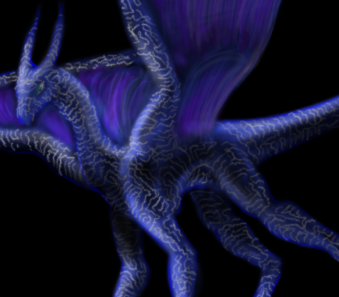
An explanation of the evolutionary history of the three known sophont species is illustrative, particularly since it provides an opportunity to show what other Avishraan lifeforms are like.
It is important to remember that a large proportion of Avishraan vertebrates are hexapods; they are six-limbed, or at least descended from ancestors that were - in the same way that snakes or dolphins are classed as tetrapods, despite having lost some or all of their limbs through natural selection. Since only four limbs are required for locomotion, particularly on the ground, it's fairly common for at least one pair of limbs to be have been specialized for some other purpose. Those vertebrates that are not hexapods are, for the most part, the equivalents of Earthly fish, though there are a few “living fossil” species of genuine tetrapods.
Let me note that, in the future, the use of terms like “insects” and “fish” and “trees” are meant to indicate that the organisms being talked about are analogues of familiar organisms on Earth - that they fill similar niches, live in similar habitats or may even have some similarities in appearance. What it doesn't necessarily mean is that any particular example could be mistaken for an Earthly species when subjected to close examination; Avishraan fish, for example, are called fish because they live and breathe in water like Earth fish, have a similar range of shapes as Earth fish, and have a similar range of lifestyles as Earth fish, and it makes sense to call them fish as the most convenient term. What it doesn't mean is that they have all the characteristics used in the definition of “fish” on Earth.
Building on this, there are a few major kinds of hexapods in particular whose characteristics should be noted. The nearest equivalents to mammals are so because they have hair or fur, but since they do not in fact have mammary glands should probably be called something else. (So, yes, boobs don't happen on Avishraa. Sorry for the disappointment.) Such beings are not uncommon, but are most prominent in difficult climates. Ecologically, many of the niches that on Earth would be the province of mammals are instead held by what could, very loosely, be called reptiles, in that many of them lay eggs and many of them have scales.
The draconiforms are of this last kind. Their ancestors were small, active, warm-blooded, arboreal animals who, somewhat like squirrels, leapt between trees in search of fruits, nuts and seeds, and the earliest draconiforms were those whose anterior pair of limbs developed into wide, flat surfaces for long-distance gliding, approximately 6.5 million cycles before the present. While modestly successful in this niche, spreading throughout the tropical forests of sekhaa, they were not found beyond it; they had competition from other herbivores such as the tantines and nitvighines, and were a welcome new source of food for flying predators such as the nakhoids.
A relatively sudden climatic change and rise in sea level approximately 4.7 million cycles before the present changed the situation dramatically. The draconiforms weathered the resulting extinction event relatively well, and certainly better than their competitors; the inundation of a number of low-lying plains resulted in the development of extensive wetlands and mangrove forests, rich in fish and other small, aquatic prey, and a number of draconiforms turned to a piscivorous lifestyle and, later, developed true flight.
Between 4.4 and 2.8 million cycles before present, the draconiforms underwent a massive expansion and diversification. By the end of this period, they had became a ubiquitous sight along shorelines of oceans and other large bodies of water, and the longer-flying species could make long oceanic and continental crossings. Despite this, they made slower inroads into the interiors, tending to cling to areas where water was readily available.
By 750 thousand cycles before present, one draconiform species occupied a niche something like that of a wading bird, with four long, spindly legs with webbed feet, a long neck, and a long, thin muzzle used to probe the water and bottom for food. A number of its descendents, however, tended to range further and further from the water and strike out into the grasslands; these largely terrestrial species formed the takmoids. Most were small, social predators, less than a meter in length. One lineage, however, the takmids, grew larger and sturdier, relying less on flight to locate small prey and more on cooperation to take down larger prey; they diverged fully from the other takmoids by 91 thousand cycles before present.
Here we come to familiar territory, because all three of the known sophont species are takmids. At least the tendency to bipedalism appeared before they diverged, as did the empathic faculty; however, it is evident that language and tool-using developed independently.
What is known is that, by 74 thousand cycles before present, the takmids eventually diverged into at least two groups due to geographic separation. One, the dvidalins, adopted a mostly bipedal mode of locomotion and completely lost the ability to fly, their wings becoming vestigial; there are several living species of dvidalins, and most of them are fairly intelligent, though the orghysh are the only ones to have complex languages and social structures. The other was what might be called the takmins: the descendents of the proto-takmar.
The proto-takmar inhabited what is now the desert called the brightness, but which was, at the time they diverged from the dvidalins, considerably less arid and mostly grassland, though still less lush than the regions inhabited by the dvidalins. It was, at least, a resource-scarce enough environment to result in a number of adaptations, one of which was (at around thirty-five thousand cycles before present) cooperative polyandry: family units consisting of one female and multiple males who looked after and fed the young, where a single male-female pair might have difficulty doing so.
The proto-takmar subsequently developed into a network of largely geographically-tied female-led packs tied together by more nomadic packs of males (at this stage, traveling together in search of mates and homes). If complex language had not already appeared by this point, the social bonding required to glue these units together certainly spurred its development, and packs, especially crowded together near rivers or in other resource-rich areas, began to acquire higher levels of organization to mediate disputes.
Between eighteen and nine thousand cycles before present, the Brightness underwent the increase of aridity that brought it to its present state. While riverbanks and scattered oases and wadis remained capable of supporting large populations, the grasslands beyond increasingly turned to desert, and competition for resources became fiercer. This ultimately drove a wedge between those able to cling to their verdant lands, who were able to retain their complex societies and higher population density, and those forced to survive on increasingly marginal land, who only survived by breaking up and roaming. What began as a social divergence increasingly became a genetic one as well, as the desert-dwellers - the ancestors of the xtauh - became smaller and better adapted to low humidity, and started to be rejected as mates by the river-dwellers.
As desertification continued and minor streams and rivers continued to disappear, however, the river-dwellers became desperate for new living space, and waves of refugee populations departed in search of new lands. Many of them died in the desert, or settled alongside the desert dwellers and were among those who became the xtauh. Beginning in fifteen thousand cycles before present, however, several waves of settlement managed to brave the pass at what was later known as Tavath's Gap and cross into the upper reaches of the Sahvarr watershed and down into the cerulean_tangle. It was these populations who became the ancestors of the takmar.
There remained some level of gene flow between the two populations, with the inhabitants of the Brightness river valleys and the uplands on either side of the Spine providing a genetic bridge, but this gradually slowed to a trickle as the xtauh and takmar continued to diverge further. By six thousand cycles ago, large-scale interbreeding had ceased, with most genetically intermediate populations having been assimilated into one or the other. The two species still bear a strong physical resemblance, but hybrid children, if viable at all, frequently suffer health problems.
…aaaaaand holycrapthatwaslongerthanIthoughtitwouldbe. Not sure what to do next. Maybe explore some of the differences between takmar and xtauh in the present day.