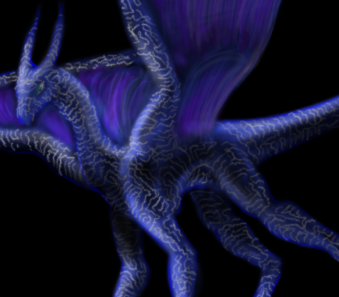
A world of the Thuban continuity, written by Ilirith.
Gwaai is a young world orbiting a sun in the faint early stages of its development; it is relatively inhospitable, being on the very edge of habitability for Avishraans. The surface is highly volcanically and tectonically active, and consists mostly of rock, interspersed with seas around the equator. The atmosphere is thin and contains high levels of suspended particles; although it is nominally breathable, safe operation there requires an avoidance of overexertion and a face-covering capable of excluding dust and other particulates from the respiratory tract. Goggles are also recommended, if available, to protect the eyes.
Life exists on Gwaai, but it is entirely microbial in nature, is restricted to the seas and the areas immediately around them, and is apparently unrelated to Avishraan life. They are responsible for the breathable gases in the atmosphere, but also for the intriguing crystalline structures that can be found growing around the margins of the seas. Continuously generated through a combination of biological action and mineral deposition (both by water spray and out of the the atmosphere), these crystals have the unusual property of being able to absorb and store energy (usually from a wide variety of sources) and release it again (usually in one particular form). In their natural environment, the crystals will grow continuously; they can be shattered, but so long as they remain nearby will generally grow separately. Once removed to a different environment, however, they are likely to be in conditions unsuited for growth, particularly since the microbes that support the process are extremely sensitive to environmental changes. Such “dead” crystals will continue to channel energy in the same fashion as before, but will lose mass when doing so until finally crumbling away entirely.
Like most of the worlds Ilirith has Written, Gwaai was intended as a source of raw materials that cannot be easily found on Tarrabor. It is these crystals that Ilirith seeks when she comes to Gwaai, since it appears that magic is one of the forms of energy they are capable of absorbing. In particular, those capable of emitting light and heat when “charged” are valuable to her, since they allow her access to both without resorting to fire or other easily detected methods of producing them.
Although the necessities of survival on Tarrabor give Ilirith little time to study the other kinds of crystals present on Gwaai, one particularly obvious (and relatively rare) kind, dubbed by her as “drifters”, appears to solely and continuously absorb gravitational energy, emitting it again as light. The result is a crystal that, when not fixed to other objects or the ground, floats above it at a set height determined by the mass of the crystal: the larger the crystal, the higher it rises before stopping. An immature drifter, growing from the margins of the water and still attached to the underlying rock, is difficult to detect; but as its mass and therefore its levitational ability continues to increase, one of two things results:
- If the structure of the crystal is weaker than the rock it is attached to, pieces will, at intervals, splinter off and float freely. In regions with many drifters of this kind, this may result in low-level “clouds” of crystal shards, blown about by the wind. If the clouds remain near the sea and conditions remain favorable for growth, the drifters will continue to grow while airborne, gradually rising until they reach an altitude beyond which their microbes cannot survive. Otherwise, the clouds will disperse, lose mass, and sink back to ground level.
- More rarely, if the stucture of the crystal is stronger than the underlying rock, and the crystal(s) massive enough, it is capable of wrenching loose its substrate from the ground and becoming a free-floating island. These may present a hazard to travellers; low-altitude islands capable of interfering with objects at or near ground level can remain close enough to the sea to be self-sustaining, while high-altitude islands, though not dangerous on a casual basis, can drift high enough that their crystals “die”, resulting in the islands falling slowly (or, in the right circumstances, quickly) back toward the ground again.