Table of Contents
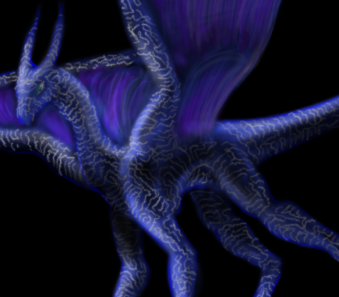
The Avishraan dragon species in the Thuban continuity loses some of the characteristics of Avishraan dragons that make the Amberworld dragons so especially unique. For example, the aquatic roots are entirely glossed over - there are no elongated hands, no trace webbing, and the body isn't particularly designed for swimming (though they can). The eyes aren't faceted, either. Furthermore, the antennae of Thuban-continuity Avishraan dragons are a bit thicker than their Amberworld counterparts, and fleshy, mostly because they're an important part of the species' emotional communication and thus need to have at least some decently-sized muscles for fine(-ish) motor control. Finally, mind-links are not a Chosen trait, but a trait of the species as a whole.
There are no notable size differences between Chosen and regular Avishraans, though if they're visible, Chosen are almost always smaller than their Avishraan cousins. Females, however, tend to be a bit larger than males and stronger in build, making for better hunters and fighters.
Lifespan

Avishraan dragons tend to reach a reasonable approximation (85%+) of their adult size after ten Earth years (67 Avishraan years), though they continue to grow a little after that point until 100 EY / 670 AY, at most until 120 EY / 400 AY in some individuals.
They enter their species' equivalent of puberty at 60 EY / 400 AY, which ends around 120 EY / 800 AY and fortunately isn't associated with quite the severity of emotional shift as in human beings (lest they might drive their parents insane).
At 300 EY / 2000 AY, their body's ability to regenerate begins to introduce visible signs of ageing, which start having negative physiological consequences at 600 EY / 4000 AY.
On average, Avishraan dragons live 750 EY / 5000 AY; however, regular Chosen tend to, in large part due to their already dodgy health, in part out of the strain of having an extra organ to maintain, rarely even reach a senior age.
Emotive expressions

The main form of emotive expression in Avishraan dragons is encoded in the posture of their antennae. Much as humans have evolved a fine sense of the subtleties of facial expression, Avishraans have a keen eye for the precise direction and curvature of both antennae, so that even subtle twitches of emotion can be interpreted. A skilled empath would be able to determine a lie just by looking at antennae… but deeply skilled empaths are quite rare since mind-links are an important part of family and friendships.
The eyes of an Avishraan are a secondary form of emotive expression, akin to lips in a human being - they strongly help identify an emotion at-a-glance, but they're also considerably easier to manipulate into showing an insincere emotional response. As such, the aforementioned lies are often visible by eye-expression and antennae-expression painting incompatible pictures of the dragon's emotional state.

Finally, the mouth in an Avishraan dragon does not convey any one flavour of emotion at all, but usually indicates the degree of emotional involvement. This is akin to volume-of-voice and tears in human beings. A wide open maw with drawn back lips conveys a visceral emotional response. Like the antennae, this is commonly a subconscious motion and takes much effort to fake, thus can be assumed to be genuine.
Mind-links
Mind links in Avishraan dragons are in part instinctive/hereditary and in part forged by conscious decision.
Mental connections convey multitudes of information down to individual thoughts (though only skilled psychics will be able to make them out in their semantic meaning given that the mental maps of information-to-raw-thoughts differ from individual to individual), but only emotions and nociception tend to be interpreted by all participants.
Individuals will have a mind-link to members of their family from birth, and mind-links to acquaintances by choice. Establishing a mind-link against someone's will is difficult, but not impossible - it's a question of having a greater willpower than the victim; the bigger issue tends to be keeping them there, as a mind-link can be eroded away by any one party.
Natural deaths - the gradual failing of an individual's physiology - have no negative effect on mind-links, but abrupt, unexpected deaths register much as the worst sort of pain possible and tend to corrupt large swaths of the mind-linked survivor's psyche. These areas can be gradually recovered except for those pieces that 'scar'.
Culturally, mind-links are considered necessary for many recurring social interactions, though they aren't - they do grant a sense of familiarity empathy alone does not grant, and the information sent through them cannot (as far as anyone's aware, at least) be tampered with, making it the most genuine connection anyone can have with anyone else. Davir Sria tend to have an above-average tendency to mind-link, whereas Davir Kaea have a below-average tendency to mind-link, but neither Brotherhood deviates so strongly from the baseline as for this to stick out like a sore thumb or cause culture clashes.
Dragons entirely devoid of mind-links are rather rare and tend to be viewed as complete kooks, attracting pity and horror alike from their fellow dragons. There are a few small Avishraan clans that outright refuse to engage in mind-links for paranoid or philosophical reasons, but they're such a small minority they can be considered a fringe phenomenon at best.