This is an old revision of the document!
Table of Contents
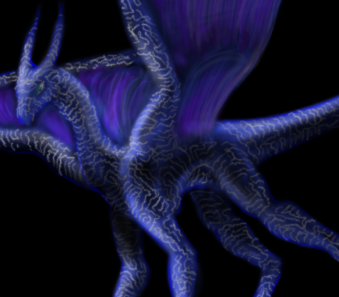
The species known as the takmar in Imperial (plural; singular takma) are a species of intelligent dragon that are the most numerous sapients on Avishraa and the creators of its most advanced civilizations. As with humans, this gives them no great claim to moral superiority - takmar are as prone to stupidity, hatred, greed, and violence as they are to kindness, love, charity or art. But they are not evil, though individuals may be, and although their standard of living is what one might expect from a medieval society, many of them nonetheless live lives that, by their own standard, are good enough, if imperfect.
Numerical characteristics
- Lifespan: Up to 19 cycles (100 Earth years); 11-12 cycles closer to average
- Average length: Adult females are an average of 3 meters long, nose to tail, with a 5.75 meter wingspan; adult males are an average of 2.5 meters long, with a wingspan of 5 meters
- Average weight: Adult females average 262 kg (225 kg in local gravity) adult males average 150 kg (131kg in local gravity)
- Average physique: Female takmar tend to be more generally muscularly developed than males, except in the chest, where males tend to have more powerful flight muscles
- Body tint, coloring, and marking: Overall body color tend to be found in either a brown-red-yellow range or a purple-blue-green one; females have olive-colored markings on face and back
Anatomy and physiology
Shape and features
See also the articles on the takma body and on scales and coloration.
Takmar are large draconiform hexapods. Put another way, they have six limbs; a pair of hindlimbs, used exclusively for walking; a pair of forelimbs, shorter than the hindlimbs, which can be used either for locomotion or for fine manipulation; and a pair of wings, used in either flying or swimming. Each limb has four digits; those on the forepaws form three fingers and an an opposable thumb, those on the hindpaws three toes and a non-vestigial dewclaw, and those on the wing three main spars and a tiny, largely vestigial, thumb. The spars are connected to each other, and to the sides of the body and tail, with a thin web of skin.
The head is of a more or less aerodynamic shape with a long muzzle. The teeth are generally conical, although those toward the rear of the mouth have truncated, almost flattened, points. The nostrils can seal while underwater. The eyes have catlike, slitted pupils, and are usually light in color, typically some shade of blue, gray, or washed-out green. Other colors, such as gold, are possible. Takmar do not have ears, but instead a pair of antennae; long, flexible, backwards-sweeping structures with hollow interiors. The set of the eyes and antennae, and to a lesser extent the mouth, play a major role in takma facial expressions.
Motion and locomotion
See also Body language.
Takmar are capable of either a bipedal or quadrupedal gait on land. The latter, which involves curling the fingers and placing the weight on the knuckles, is more comfortable for both standing and walking/running for any great length of time, but prevents easy manipulation of tools. The former, meanwhile, frees the forepaws for other activities, but bipedal standing and walking places stress on the lower back and results in somewhat more delicate balance. Most takmar resort to a bipedal stance only when they need to reach an additional height, or in situations where a balance needs to be struck between motion and manipulation (as with handling weapons in warfare); if manipulation can be accomplished while remaining still, they will simply sit on their hindquarters. Because of their higher center of gravity, males generally find the bipedal stance more difficult to enter and maintain than females do.
The takma neck is only slightly longer, proportionally speaking, than a human neck. It is more flexible, but far more so toward the chest and the sides than toward the back; when quadrupedal, the head can be tilted up, but cannot lift very far above the trunk of the body without experiencing neck pain. Getting a better view may involve lifting off one's forepaws temporarily.
Takmar frequently have trouble reaching their own backs. The neck is not long or flexible enough to twist the mouth around to reach, nor can the forelimbs rotate backward far enough to reach anything but the far upper and lower back. The wing-thumb can be use to clumsily scratch the upper back, but this is frequently not considered satisfying; the tail is prehensile, but has relatively poor motor control. Grooming by other takmar, therefore, is often an important part of social bonding.
In Avishraan gravity, which is slightly over 86% that of Earth's, healthy, fit, adult takmar are capable of flight, but will become rapidly exhausted if carrying more than a small amount of weight. Females' larger size and proportionally smaller wings mean that they tend to be weaker fliers, and a pregnant or overweight female is generally unable to safely take to the air.
Senses and perception
See also Senses.
The takma senses are broadly comparable to those of humans, at least to the extent that they would be able to detect many of the same stimuli. That said, their visual and auditory ranges are not identical, and the takma sense of small is somewhat poorer.
Takmar also have a sense that is absent in humans: the ability to directly perceive emotions and feelings from other beings, referred to as the empathic sense. This is not unique to takmar among Avishraan species; several related species possess it, and different manifestations of the same sense have arisen independently many times throughout the evolutionary history of the world.
Taxonomy and evolution
Ancestry and relatives
The closest living relatives of the takmar are a species referred to in Brightness Imperial as the xtauh, from whom they began to diverge some eighteen thousand cycles ago. Though neither of them recognize the relationship, they remain genetically compatible enough that interbreeding is occasionally possible, though extremely risky. These two species are together classified as the takmins.
The ancestors of the takmins diverged some 74 thousand cycles ago from those of the dvidalins, a mostly bipedal clade. The third known sapient species, the orghysh, are dvidalins, though there are also a number of non-sapient dvidalins scattered throughout Sekhaa; the arboreal sikirin among those most well-knwon to takmar of the Tangle.
Variations
Takmar have a much higher variability in skin color than humans do, even within the same population, and it is relatively common for children to be a different color from either parent (see Scales and coloration for details). The physical races that make up the takma species, therefore, tend to be defined based on other factors, though some colors are more common for some than for others.
There are, broadly speaking, three major racial types. The first two, which can be grouped together as the lowland races, are more closely related to each other than to the highland race.
- Lowland: Larger and heavier than highland takmar. They have longer muzzles and narrower heads and bodies, and have a higher proportion of colors in the green-blue-purple spectrum.
- Riparian: Relatively blunt muzzles and powerful jaws, and a somewhat more defined physique. Most prevalent in the inland portions of the Cerulean Tangle and adjacent territories.
- Littoral: Straight, fairly pointed muzzles, and even with healthy and moderate eating tend to have a slightly 'soft' appearance due to deposits of body fat. They are found along the shorelines of the Cerulean Tangle, and are the dominant race beginning on the Abethine Coast and west from there.
- Highland: Smaller and lighter than lowland takmar. They have shorter, blunter muzzles and wider heads and chests, and a generally bulkier appearance than lowland takmar. They have a higher proportion of colors in the brown-red-yellow spectrum. They are the dominant race in the highlands on either side of the Spine of Sirdanth.
As with human races, the boundaries between them are not distinct and there are many areas where considerable mixture has occurred. This is especially true with takma settlements in the Brightness, whose founding colonists tended to be an even mix of riparian and highland takmar whose descendants are a fairly thorough blend of both.
There is also a fourth group, whose biological status is somewhat unusual - it is clearly heritable and clearly has physical markers, but since members of the group also inherit racial characteristics independently of this, its identity as a race is debatable. This group is variously called the Chosen, or - less charitably - 'witches', and is distinguished from other takmar by far smaller size, far longer lifespan, and by the possession of innate magic. Their specific traits are addressed in their article.
Life expectancy
A takma is considered extremely lucky to live to half a hexatrigesimal - 18 cycles (97 Earth years). While this is certainly possible with a good diet and medical care, it should be noted that most takmar do not get much of the latter and many of them get neither, and so it is no surprise that a more reasonable life expectancy is more like 11 or 12 cycles (60-65 years) even for the fortunate. The main exception to this is the case of the Chosen, who are both more naturally long-lived and often have access to magical healing from lifegivers (see Magic).
Life expectancy generally increases or decreases with prosperity, although the relationship is somewhat less linear to status and gender; middle-ranking females almost always live longer than males of the same class, but both lower- and higher-ranking females tend to live only as long, or slightly less than, males of the same status. This is related to reproductive and social stress at both ends of the spectrum: lower-status females have to cope with the demands of superiors and must often care for families in situations with little spare food and no medical care; higher-status females must strive to prevent their relative status from sinking below that of rivals, and are under high pressure to bear children.
Genetics and reproduction
See also Reproduction.
In terms of sexual behavior, neither males nor females are much inclined toward monogamy. Socially, however, most takma societies are polyandrous, with a female having one or more mates who care for her children.
The female is able to exercise considerable control over both the timing and the choice of sperm used in conception; while she personally knows who fathered a given clutch of eggs, there are few perceptible indicators to anyone else. Even physical resemblance to the biological father may be obscured, since the way that colors and color patterns are inherited makes it possible for a child to have a color different from either parent.
A clutch will generaly consist of between one and three eggs; more are possible, but rare.
Ecology and habitats
Takmar are for the most part restricted to the continent of Sekhaa. Despite their affinity for water, they fear being on or in water that is too deep or too far from land, and although some cultures have overcome this to engage in seagoing travel - particularly in recent cycles - it means, combined with Avishraa's wind patterns, that they have not spread farther from Sekhaa than nearby islands, and have neither visited nor are aware of other continents.
Takmar are not, biologically speaking, as adaptable to climate as humans are. They require an overall warmer temperature range, and are most comfortable around 25 to 35 degrees C; they also require far more moisture, and need to remain in an environment that has either high humidity or sizable bodies of water available to immerse in. This means that their highest population densities are found amid tropical rainforests, marshes, and swamps. Being a sapient species, technology has allowed the range of the species to be extended into colder climes: fire, fur clothes, and well-insulated housing all contribute to survival. That said, very few takmar dare to live in climates where it is possible for water to freeze.
As for water itself, takma settlement in arid climates, such as the desert known as the Brightness, clings to rivers and oases; if large amounts of water cannot at least be transported constantly and reliably to a location, they cannot live there for more than a short time. Therefore, takma settlement depends strongly on either the presence of sufficient quantities of both bathing and drinking water or the ability to accumulate them, which in less rainy environments than they are used to can restrict them to living near riverbanks and shorelines. Traveling between these habitable areas involves either firm control of oases or the establishment and supply of artificial watering holes (or both), usually at significant expense.
Lately, the development of glyphic teleportation has allowed the colonization of other worlds, though so far this has only been done on an individual basis; no significant takma populations have been established off of Avishraa.
Dietary needs and habits
See also Diet and agriculture.
Takmar have a strong preference for the taste of meat and other savory foods, and they cannot process plant foods with large amounts of cellulose, such as leaves and stems. That said, they are facultative carnivores, and where meat is not plentiful enough, are capable of subsisting on other kinds of plant foods, such as fruits, tubers, and grains.
Having a fairly delicate sense of taste, takmar have been as inventive as humans in the use of herbs, spices, and sauces to flavor their food, either to enhance good flavors or disguise bad ones.
Behaviors
See also Behaviors.
While takmar, like humans, have a wide variety of practices based in culture and religion, there are many that rest ultimately in the sociobiology of the species. The possession of the empathic sense, prehistoric territorial instincts and reproductive strategies - factors like these continue to have effects on present-day societies.
Relations
See also Relations.
The attitude of most takmar toward other sapient species tends to vary between dismissive and genocidal. The most numerous and technologically advanced species on Avishraa, takmar have relatively little reason to feel impressed by either the xtauh or the orghysh, and are inclined to push them out of land that they feel could be put to better use.
- takma:behaviors#Apaternalism
- takma:behaviors#Courtship
- takma:behaviors#Empathic silence
- takma:behaviors#Grooming
- takma:behaviors#Male bands
- takma:behaviors#Social status
- takma:behaviors#Territoriality
- takma:behaviors#Thalassophobia
- takma:body#Face
- takma:body#Olenor
- takma:body#Sexual dimorphism
- takma:body#Tail
- takma:body#Wings
- takma:senses#Olfaction
- takma:senses#Vision