Table of Contents
Takma body language
Bodily movements
Facial expressions
Like humans, takmar use the movements and set of the face to convey emotional states. (The use of empathy is a more direct and reliable indicator if it can be used, but is customarily rendered irrelevant through shielding.) However, what counts as the face, and the amount of attention paid to each part, is somewhat different.
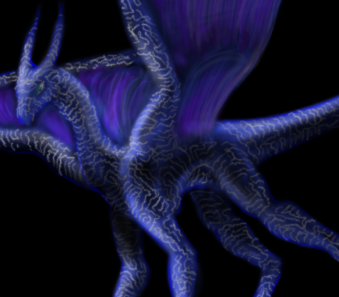
Likely the most important conveyors of emotional state are the pair of structures known in Imperial as the olenor (sing. oleno), usually translated into English as 'antennae' or 'stalks'. These long, fleshy, hollow structures serve as a takma's organs of hearing, but can also be tensed or relaxed in various directions using narrow strips of muscle along their lengths. The set of a takma's antennae conveys as much, if not more, information as the set of a human's mouth.
Having many blood vessels near to the surface, the antennae also play a role in thermoregulation, and when excited or worked up in a way that raises the body temperature, a takma may 'blush' or 'become flushed' with a darkening of their color as the blood vessels dilate.
The region around the eyes, meanwhile, does, like humans, also convey emotional state. Aside from the degree of closure of the eyelids themselves, muscles above and below the eye socket draw their associated skin and tissue into particular configurations.
A takma's mouth is somewhat less expressive than a human's. There are no lips, in the human sense, though there is some flexibility to the edges of the mouth - less at the muzzle tip or the corners than on the sides of the muzzle. This is generally sufficient to bare one's teeth, and the degree and manner of doing so plays a part in conveying the intensity of emotion, but little else (though, by itself, it may also be taken as a sign of aggression).
(Gallery of facial expressions here)
Head
Movements of the head also play a role in conveying information. While these are usually far more voluntary and subject to cultural variation than facial expressions, there are nonetheless some broad trends in how they are used.
Expressions of approval or agreement are generally through gentle up-and-down motions; not a tilting of the head, as with a human nod, but a lifting and lowering of the entire head though motions of the neck. Disagreement or a negative answer to a question are expressed through a downward tilt of the head and muzzle.
An indication of uncertainty or indifference, approximating a human shrug, is generally performed with sharp motions of the head to one side or the other. In most of the lands under Imperial cultural influence, this takes the form of a quick sideways twist of the head around its long axis. This is typically only done once, to one side, and no more. To twist the head rapidly from side to side, as if shaking off water, is an expression of dismissal or rejection - as a response to a question, it would not be considered an answer in the negative, but rather a refusal to consider the question at all.
Holding the head high upon a neck stretched upward is a sign of control or dominance; to hold the head slightly backward from its default position, so that the head is above the shoulder blades, has a similar effect but suggests an additional sense of relaxation, confidence, and effortlessness. Submission is conveyed by a lowering or dipping of the head forward.
A forward jabbing motion of the head and muzzle is used as a sign of assertion, almost to the point of aggression. The precise effect it conveys varies depending on the user's expression and words, but generally is used in arguments, disputes, and status interactions to intimidate another or to emphasize one's own position or perception. Combined with bared teeth, snapping of the mouth, and/or an angry expression, it may be the prelude to a violent outburst or attack.
Forepaws and forelimbs
Wings
The degree to which wings are opened or closed rarely conveys any feelings by itself, but can lend emphasis to other components of body language.
The usual wing position of a takma at ease is a loose folding. Wings are usually only tightly and tensely folded against the body when the takma is cold, afraid, or feels physically or mentally boxed in.
While attempting to assert oneself before, or intimidate, others, the wings may be loosely unfolded and frequently turned upward to face their ventral surfaces forward. This increases the surface area presented to a viewer and gives the visual impression of greater size.
Fully unfolding one's wings is a (somewhat ostentatious) way of attracting attention to oneself, not only visually but often physically, since doing this often hugely inconveniences those immediately surrounding the takma in question. How well this is received depends on what the user does with it; but it is acceptable, if used with discretion and decorum, to use it to bring attention to a following announcement, especially if the user is of higher status.
Among the less voluntary gestures, flapping the wings, other than as part of takeoff, is a sign of uncontrolled excitement. Too-frequent adjustments to their positions are seen as a kind of 'fidgeting', indicating discomfort.
Tail
Body stance
Behaviors
Face licking
The licking of the muzzle and the region around the eyes overlaps somewhat with the forms of licking involved in grooming, but is distinct in that it serves different functions. Although it can be, and often is, used for hygiene and social bonding, it is just as often an emotional reaction, occupying approximately the same range of connotations as hugs and embraces do among humans.
It is generally interpreted an expression of affection or emotional attachment, whether spontaneous or performative. Formal or perfunctory face lickings tend to involve fewer and alternating licks, whereas expressions of genuine affection tend to involve more licks and more simultaneous licking by both participants. (If simultaneous licking goes on for an extended period - not strictly defined, but the longer it is the more it is held to be true - it is generally considered an expression of romantic feeling, akin to kissing or snogging.)
If one person is licking and the other is not, it is usually assumed that the licking partner is providing comfort and emotional support to the non-licking partner, who may be tired, in distress, or merely distracted. Nonconsensual face licking is rare, since a recipient has few reasons to let it pass unchallenged and a giver has few reasons to force it.
Face licking is not always a positive reaction. The pace of licking is an indication of worry or urgency, and while slow licking indicates a relaxed situation, fast licking may be performed in times of stress for mutual reassurance. Frantic face licking is roughly equivalent, in this sense, to a human clinging to or squeezing another in an embrace.