Table of Contents
Uvereth
THE SOLDIERS: Now the fight is won, and the treacherous one is dead! Here upon this Stone let it be shouted to the corners of the world: a new House is risen! Uvereth shall be our Empress!
UVERETH: No, it shall not be so.
THE SOLDIERS: What could you mean? Who then shall rule?
UVERETH: I shall return to Inaar, where the bones of my foremothers lie. There will I rule, and preserve it from harm. But I shall choose no Empress, myself nor any other.
THE SOLDIERS: Will you then allow the Imperial horn1) to be contested by rebels and traitors?
UVERETH: By no one!
Isolated soldiers gasp and shout of impiety. Uvereth raises her hammer for silence.
UVERETH: What is this you say? You speak of impiety? Shall I tell you of impiety?
Long service and vast loss, repaid with suspicion and treachery: is that not impiety?
A dagger-stroke to my back, and others aimed at my daughters: is that not impiety?
You speak of impiety! How impious is the empire that allows such acts, against all that is taught to us by the gods?
And for what has been done, I have slain her to whom my allegiance was owed! Is that, too, not impiety?
Hear me: if I am impious, then so are we all! Indeed this is an impious age, where all that was good and true is brought to ruin; and all that we may do is save what can be saved. The Empire is not yet gone, but it is dead! The impiety of which you cry is the stink of its corpse, which has been propped up as a puppet for cruel entertainments! But the puppeteers are dead, and the corpse is freed from their strings; therefore let it be buried and the stink cleared away, and the Bone-Eater judge us all!
Uvereth brings down her hammer on the Foundation Stone, shattering it to the cries of the soldiers.
Act IV, Eldass' The Empress' General
Basic info
- Common name: Uvereth
- RP status: N/A
Biographical data
- Full name: Uvereth Tanassai
- Nicknames or aliases: the Stonebreaker, the Destroyer
- Date of birth: 20 Vigil
- Place of birth: Inaar, the heartlands
- Date of death: 3 Cloud
- Place of death: Inaar, the heartlands
Gender and sexuality
- Biological sex: Female
- Gender identity: Female
- Sexual orientation: Androphilic
Heritage and identification
- Species: Takma
- Race: Riparian
- Ethnic origin:Imperial
- Native language: early Haatar Imperial
- Other languages spoken: Classical Imperial
Physical
Overall description and build
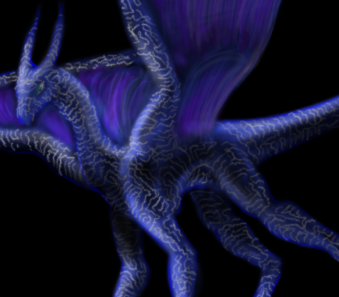
Throughout most of her life, Uvereth was muscular and heavily built; while a notably poor flier, when fighting and close quarters she was a fearsome opponent. She gained a significant collection of scars and other evidence of injuries during her career. Toward the end of her life, she became wasted and pale from long stress and illness.
Her scales were predominantly maroon, with dark green mottling on the throat and belly.
Facial description
Uvereth's face was squarish and rough-hewn, with a blunt muzzle; she had a brutish look that, while intimidating, belied her eloquence. Her eyes were grayish-blue, and her facial markings were a symmetrical collection of rough triangles. The tip of her left antenna was sliced off early in her military service, so that it was shorter than the right.
Apparel and accessories
When not on campaign, Uvereth was fond of bright blue robes; although she preferred a far simpler cut than was usual among the late Imperial elite, she made no attempt to avoid having them made of fine materials. She was said to be fond of bright blue linen with gold accents.
On campaign, and especially after she became well-known, she had a personalized suit of armor made that was elaborately inlaid with brass on the helm, gorget, and backplate, depicting Imperial symbols and representations of her lineage. Most of the rest of the torso was covered by scale armor, with chainmail sleeves for the tail, forelegs, and upper hindlegs (the lower hindlegs were covered by greaves).
Uvereth's preferred weapon was the war hammer, and she was known to go into battle either with two one-handed ones - one for each forepaw - or a heavy, two-handed war maul.
Mentality
Motivation
For most of her life, Uvereth's greatest motivation was loyalty to the Empire, and a desire to defend it and restore its past greatness. When she was brought to the realization that the Empire's greatest threat was its own institutions, she underwent a crisis of faith and eventually contented herself with staking out her own territory and protecting it.
Virtues, vices, and flaws
Intellectual characteristics
Uvereth's most famous aptitude was that for military command. She had a natural grasp both for strategy and tactics, made all the keener over time by both experience and study. While it would, perhaps, be bold to cite her as the greatest general in history, by the end of her career she was certainly among a select few that might be thought the greatest of their era.
She was known to be a fancier of music, and was a particular devotee of the othtin, a sitar-like instrument. Although she did not play the instrument herself (at least not well), she is known to have composed several pieces for it. Though the pieces themselves have not survived, they were apparently considered unusual in their use of rapid changes of tone and tempo. Uvereth is recorded as having said, in response to a question about this, “Both music and war bring swift changes; it is as well to be ready for them.”
Morality and philosophy
Uvereth placed a high price on loyalty in general, and loyalty to the Empire in particular. Her family had, for generations, made a tradition of Imperial service - usually in the military, but often also in administrative roles - and she had been raised in the belief that, even in its decline, the Empire was the last true bastion of civilization, beset on all sides by darkness and ignorance, and that it could never fall so long as it remained uncorrupted.
This view at first remained intact despite her frictions with the Empress Ilvrith. But when, at the Empress' orders, an attempt was made on Uvereth's life and those of her family, her view of the Empire was catastrophically broken, resulting in her successful rebellion. Her remaining years were marked by dejection and mistrust of all but her loyal armies and her closest relatives.
Religious views
Social aptitude
Likes, dislikes, and taboos
Habits, quirks, and mannerisms
A number of ancient commentators noted that Uvereth was famous for her stillness while concentrating, but when less occupied preferred to remain moving, having a habit of pacing or fidgeting while in conversation.
Traumas
While she spent much of her life either fighting in or leading militaries, she seemed well prepared to cope with the stresses and horrors of that life.
Far more disturbing to her was the attempt of the Empress Ilvrith to eliminate both her and her heirs; after the end of the Empire, Uvereth was famously mistrustful of those who were not very close to her, and experienced difficulty sleeping. Over time, she became increasingly paranoid of both knives and poison, to the point that after having her food tasted by others, she preferred eating it without the use of utensils.
Personal resources
Aptitudes and abilities
Uvereth was most famous as a military genius. Aside from a talent for anticipating enemies' moves, she believed strongly in the value of having control of correct information: both gathering it for herself and denying it to her foes. Using these traits in tandem, she had a reputation for misdirecting and outwitting opposing forces that might otherwise have had the advantage.
While not a player of the sitar-like othtin, she was extremely familiar with its music and apparently composed some notable pieces for it.
Weaknesses
Learned skills
Education
Like the daughters of many highborn Imperial families, Uvereth was privately tutored during her childhood, learning reading, writing, history, and etiquette. Her mother having been an experienced commander in her own right, she personally oversaw her daughter's training regarding military history and strategy.
Her education continued in a less formal way through attendance at facilities attached to several major temples in Kar Iitan: she mixed with others of the elite classes at the Temple of the Most Eminent, including some of the Empire's top military leaders; the Temple of Ekhtun the Soldier brought her into contact with ordinary soldiers, and introduced her to their concerns and needs; and through the Temple of Laishar the Singer she gained access to some musical training.
Occupation
Wealth and possessions
Personal history
Childhood goes here
As she grew older, she spent time at the Temple of the Most Eminent, which tended to attract generals and great warriors, as well as others in the “right” circles, for Uvereth to meet and come to know; her regular attendance there was pleasing to her mother. Somewhat less so, however, were the other temples she attended.
The Temple of Ekhtun tended to be more frequented by male and lower-class female soldiers. While, in mixing with their congregations, Uvereth gained a familiarity with their capabilities and needs, her family felt that being too close to the lower classes was a debasement of her heritage. Even this was better, however, than the time she spent at the Temple of Laishar and its musicians, for the former might be excused by its practical utility, while the latter was pure frivolity. Uvereth, however, had a passion for music, as well as for its practitioners, and it was with this in mind and characteristic confidence in her own choices that she permitted a temple regular and othtin player, Kovath, to court her.
It was partly in furtherance of Uvereth's education and social status, but also to sever her links to Kovath, that in 22 Vigil her mother provided her with a letter of introduction and commanded her to present herself at the Imperial court in Kar Iitan. While she dutifully went, Kovath responded by immediately joining a merchant band and traveling after her. Away from her mother's supervision, she quickly married him.
Career from early military deployment onward goes here