Table of Contents
Orghysh
The orghysh (sing./pl.) are a sapient species - scaly, spindly, and bipedal - native to the Sea of Grass in western sekhaa. In numbers, technological development, and social organization, they lag far behind the takmar or even the xtauh, to both of whom they are distantly related - all three species being takmids.
The takmar have lived in close proximity to the orghysh for ages - since at least the days of the Sixfold Empire, if not before - but the two species have had surprisingly little to do with each other until the last dozen cycles or so.
Physical description
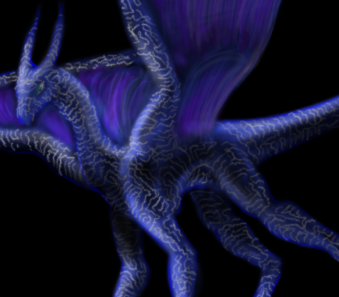
The orghysh are medium-sized draconiform hexapods. They are bipedal and possess two arms, used mostly for manipulation; two legs, used for locomotion; and two vestigial wings, used mostly for display and thermoregulation. Each limb has four digits: each digit on the arms and legs is tipped with a broad, short claw (the digits of the wings have none).
The orghysh have, on average, a proportionally bulkier upper body and chest than humans do, with long, wiry arms and a slightly hunched posture. Although they do not typically need to use their arms as an aid to walking - their thick, heavy tails providing some measure of balance - an orghysh remaining in place for any length of time will generally stand or squat with part of their weight resting on one or both sets of knuckles.
The head is wide and flat, with a long, narrow muzzle; the mouth is full of half-diamond-shaped teeth. The eyes, widely spaced and protected by prominent cheeks and brows, have slitted pupils and irises that are most often green, gold, or brown. Around the eyes and on the forehead, there are frequently olive-colored and vaguely linear markings. Orghysh do not have ears, but instead a pair of long, flexible antenna-like structures with hollow interiors. The antennae are highly mobile, capable of being reoriented in various ways to more efficiently pick up sound; they also play a major role in facial expression. The head sits atop a long neck, and beneath the muzzle is a vocal sac that can inflate to add volume and timbre to the voice.
The orghysh possess two types of pigmentation in their epidermis. The predominant type is xanthochrome, which lends them a color in the yellow/buff/brown range and is found over the entire body. The other, erythrochrome, is reddish in color, and is produced only in specific areas of the epidermis, some of them only in response to specific physiological triggers. The epidermis, in turn, is covered by a layer of keratinous scales, which are one of two types. Massive scales (made of a single, solid layer) are largely transparent and glossy, transmitting the epidermal color beneath; cavitated scales (similar to the massive type, but with numerous “bubbles” within the scale structure) lend a generally matte and somewhat muted cast to an orghysh's color.
Male orghysh are generally taller and bulkier than females by a slight margin, and have larger wings and prominent tusks; while females have larger, and internally more complicated, vocal sacs, capable of producing louder and more variable sounds.
Evolutionary history
74,000 - dvidalins diverge from takmins