Table of Contents
Lamnar
The raft slapped down upon the water with a jolt that was frightening to feel. There was an impressive spray of sea-foam when it hit, but since the rain was a vertical flood anyway, Ètukyil barely felt the difference on his face. He shivered, and groaned as the raft tilted sideways again.
He was a fisherman. He'd been one for three cycles now, he'd done it like anyone else did - you lashed together a raft, loaded up some baskets and harpoons, paddled it out beyond the waves, and then dropped a rock tied to a rope as an anchor. Then you could dive for fish, harpoon in paw, as long as you liked, and use the raft as a platform.
And then, earlier, when he'd surfaced from a dive, the wind had picked up and the raft was gone, its rope snapped. He'd flown around looking for it, and he'd found it, but by then the clouds were looming over the horizon…
Ètukyil knew now that he should've just flown straight to shore, then and there. But he hadn't wanted to abandon his raft or his catch, so he'd started paddling, only to get caught in the storm. And now it was too windy to fly, and his baskets of fish had long gone overboard. He was trapped.
His prayer to hadim the Fisher had gone unheeded. The Great Mother and To'an the Father had sent Their sympathy and sorrow, but little else. They couldn't reach him. Nyèlik the Mariner might, but he wasn't a real sailor, not like those crazy bastards that went around in real ships. He was in the paws of other Powers now. He retched - to no effect, he'd already long emptied his stomach - and tried to form the words of a prayer.
“Shēlkam, Queen of-” He paused as the raft slid down a wave and hit the trough. “-of the Storm… please let me return to shore, to see my children again… and, I promise, I will place a sacrifice on this cursed raft and set it alight and adrift, for You and Your brother Adyenor, Prince of the Sea.” He found himself weeping. “I'm not ready yet. Dark-Eyes awaits everyone, but not me, please, not yet…”
And after that, there was nothing else to do but hold on and wait.
When at last the wind began to die down and the waves became less choppy, he dared to look up. In the distance, just on the horizon, Ètukyil made out a shoreline of rocks and cliffs. It was a threatening sort of coast, utterly unfamiliar, and to him it was the most encouraging sight he'd ever seen.
He simply paddled with his hind legs at a pace he could sustain; the logistics of getting ashore could wait. Much as he wanted to abandon the raft and fly for dry land, he no longer had the strength.
Besides, he'd made a promise. He didn't dare try to break it.
The imperial_religion holds that there are two classes of deity that shape the destiny of the world. One, the siathar, are the gods of civilization, of social roles, and of everyday life; they are the ancestors and protectors of takmakind.
Then there are the beings known as the Lamnar (sing. Lamna, 'a numinous power or force'), who are quite different.
The Lamnar are the deities of cosmic forces and natural phenomena, the ones that civilization can only weather rather than hope to tame. The eruption of a volcano, the flooding of a river, the fall of a star - all these are the domain of the Lamnar, and their tendency to inconvenience any mortals in the way means that their patrons are to be approached with caution.
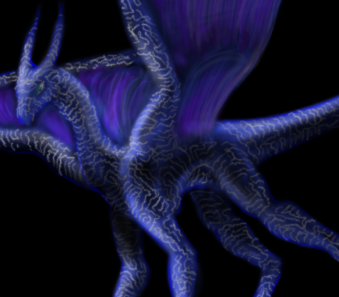
The creation myth tells that, long before the world was brought into being, the Lamnar existed in the primal Void that was then the entirety of reality. Their concerns and priorities are often alien to the takmar, and vice versa, and they are said to see mortals as brief, tiny, and fragile things, much as a takma might see an insect or worm. They may take the shape of takmar, if it so pleases them, but this is merely the presentation of a familiar outward face, suitable for dealing with mortals on those occasions in which they deign to do so.
And, sometimes, mortals will indeed attempt to gain their attention; considering how pervasive their influence is, it is often considered necessary to do so - particularly in places and occupations that bring takmar close to natural forces. They may provide aid or protection when pleased, or wreak havoc when angered, so it is thought wise to attempt to keep their favor. Still, it is not done lightly and is known to entail some risk; their moods are unpredictable, and it is often hard to know what action a worshiper has performed to provoke a reaction, or even whether the Lamna in question has noticed the worshiper at all. They are not so much hostile as capricious, and are worshiped largely in hopes of keeping them placated.
It is considered vitally, vitally important not to ask one Lamna to intervene against another, lest one manage to anger both. The Lamnar will war against each other of their own free will, but are held to become very angry when a mortal attempts to use them as tools.
Hierarchy
The Lamnar are, by and large, neither organized nor ranked; they are peers, a collection of sovereigns. Some are more vulnerable to others, and some are more closely allied to others, but none is weaker than any other in their own spheres.
The exceptions to this dynamic are the two known as the Diarchs: seluurin, Spirit of Order, and khezri, Spirit of Chaos. They are the creators of the other Lamnar, of the entire universe in general, and of avishraa in particular, and because their domains contain all others, they are the ultimate lords of creation and the final adjudicators of disputes among the Lamnar.
Known Lamnar
- anedir, Prince of the Sea: the god of the upper levels of the sea
- Ba'uk, the Eater of Bone: the judge and guide of the dead
- cherkin, Queen of the Storm: the goddess of thunderstorms
- idrizal, the Wrath of Flame: the goddess of fire and lava
- khezri, the Spirit of Chaos: one of the Diarchs, the original Lamnar
- seluurin, the Spirit of Order: one of the Diarchs, the original Lamnar
- uvuun Dark-Eyes: the personification of oblivion, the god of doom and the abyssal depths
- ytannik, the Changer: the god of physical transformations, including alchemy and chemistry