Table of Contents
Daxelh
Je-Daxelh [ˌd͡ʒe.ɖa.ˈxɛɮ], or more simply Daxelh [ɖa.ˈxɛɮ] (in Ixhwambexti), also known by a variety of other names in various languages and cultures, is the main deity of the mythological-religious complex sometimes referred to as Eyes of the Sky found in the central Brightness. She is a celestial goddess - the personification of the sky - and the mother of the world, both creator and protector.
She may possibly be the mythological conception of the Extrinsic known as Remembrance.
Names and epithets
Appearance
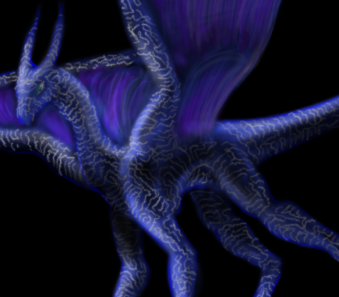
Daxelh is depicted as a xtauh of immense size; her scales are the black of the night sky, dotted with the lights of the stars. The interrupted reddish glow on one side of the sky makes up her status-markings; the brighter whorl on the other is the coloration of her belly, a physical manifestation of her fertility. Her shining eyes reflect the duality of her watch over the world; the Burning Eye is hot with golden fire, accusing and deadly, while the Gentle Eye, cool and silver-white, is soothing and nurturing.
Realm
Daxelh is thought to live amidst a vast grassland, waving endlessly in a pleasantly warm wind beneath eternal twilight, rich in game and water. It is inhabited by the souls of those who have died after unshameful lives, who may dwell there without care for eternity.
Daxelh herself remains in a nest in this realm's center, curled protectively around her eggs, of which the world is one; the others, consisting of the other moons of Kastun and the other planets of Mikurmiya, are thought to have their own inhabitants (of which nothing can be known prior to death, though it is usually assumed that as children of Daxelh they are at least vaguely xtauh-like). So complete is her encirclement that, except on rare occasions, those living within cannot see or pass beyond.
Worship
There is no priesthood for the worship of Daxelh; her devotees have a direct and intensely personal relationship with her. She is effectively a mother-figure - indeed the literal ultimate ancestrix of all creation - and the bond with her is one of familial reverence and love. Worship is generally intended more to show appreciation or to obtain spiritual relief or comfort rather than to elicit physical assistance, for although Daxelh is considered to play an immense role in the ongoing existence of the world, this does not always scale down well to the concerns of single individuals. Though fortuitous events may be the ascribed to Daxelh's intervention, they are not predictable, and specific requests and needs are more adroitly handled by spirits of various types.
Worship typically takes the form of simple prayers of thanksgiving to Daxelh or the general wishing of consequences (good or bad, depending on the intended recipient) for some person or their soul. A more emphatic form of devotion may be made in the form of votive offerings, traditionally representations of Daxelh herself or of particular aspects of the sky; or else by the vowing and completion of some task thought pleasing to her, particularly if it involves personal hardship.
Though Daxelh is believed to be able to take note of worship wherever it is performed, it is preferable to do so with an unimpeded view of the sky, outdoors and in clear weather. As a result, there are no temples to Daxelh in the sense of actual buildings. High places, being closer to Daxelh, are considered auspicious places for worship and sometimes - particularly the summits of hills and mountains - are considered attractive enough for this purpose that shrines may be constructed on them for the deposition of large numbers of offerings. Of a similar significance are places of astronomical import: places where the sun casts shadows at a particular time, or where celestial objects rise or set behind a significant part of the landscape. There are cases of megalithic structures made specifically to create such a place, but since in most of the range of Eyes in the Sky population is relatively sparse and uncoordinated, these are few and generally not of an expansive size.
While some spirits are thought to accept sacrifices of living things by death or destruction as a religious practice, Daxelh herself does not, considering it abhorrent to do so in her name. Devotees of Daxelh are philosophically at home with the idea of violence and death being unavoidable and often necessary parts of life; almost all of them turn to hunting or herding to obtain meat, and many of them turn to raiding or war to obtain resources or thin the numbers of their enemies, and Daxelh herself may be the cause of death of many, especially when the Burning Eye is open and strong. But she takes no joy or solace in death and receives no benefit from it, and the offering of such sacrifices to her is said to anger her greatly as a needless waste.
Mythological role
Daxelh is the mother of the world and the creator of all that lives on it. She is also its protector, maintaining the conditions to keep it working and alive, both in terms of passive nourishment and active defense. Because of the sheer scale of her role and her actions in maintaining it, she is not always receptive to appeals from individuals; the things she must do to serve a greater need must sometimes cause hurt or discomfort on a smaller level. Nonetheless, she is neither cruel nor unsympathetic, and seeks - when and where she can - to support her children.
In this vein, she is understanding regarding actions which, taken out of necessity or justified reasons, may have undesirable effects. That said, she has a strong moral sense; she is unforgiving of willful evil and of delight in suffering, death, and destruction. Her Burning Eye seeks out the evil spirits and the souls of the wicked dead to reduce them to ash. Those, by contrast, who seek to live worthy lives have their departed souls nourished by the Gentle Eye; and, during the first eclipse following their passing, they may move on beyond the starry boundary of Daxelh's eternal watch.
Mythological history
It is generally held that Daxelh lived alone in her realm, until she built her nest and laid the eggs that would become the various worlds, including the one upon which the xtauh live (it is for this reason that followers of Eyes in the Sky are often among those comfortable with the idea that Avishraa is round, or at least ovoid). As each one began to crack, the world's inhabitants - plants, animals, spirits, and others - emerged from the interior and onto the land that was the shell of the egg, and Daxelh's face came close to it to see and know its inhabitants.
When the xtauh emerged in her likeness, she taught them how to live and thrive in their various environments; but after a time she withdrew herself again, for while staying so close she was required to keep the Burning Eye shut, lest her egg be destroyed. She repeated this process with each egg, then took up her watch over her clutch. When the world was faced with the Burning Eye, its heat kept the egg warm and sought out evil spirits to burn them away, though it could kill the unwary and unprepared; when it was faced by the Gentle Eye, the land received respite and life, but evil spirits were, like xtauh, more free to travel it.
The cracking of the eggs and the emergence of living things were only the beginning of the process of their hatching, as the existence of earthquakes and volcanoes makes evident. However, what will happen as the process continues - or when it finishes, if ever - is unclear.