This is an old revision of the document!
Table of Contents
A Player's Guide to Avishraa: Character Creation
1. Choosing a species
There are three known intelligent species native to Avishraa, and on the whole, the setting is intended to be played using those species. (This is not to absolutely rule out other species - there may already be, for example, a long-lost colony of blue humanoids living on a distant continent - but before using a character of non-Avishraan origin, there will need to be discussion as to what they are, what they can do, and how they arrived in and fit into the setting.)
Summaries of each species follow below. Keep in mind that while many of the descriptions of behavior are generally applicable, they should be thought of as tendencies rather than absolute prescriptions for how a character should look or act; as with humans, individuals may stand out in either respect.
Takmar and xtauh
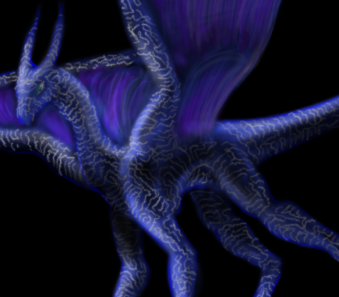
These are by far the most common natives of Avishraa; though they are functionally separate species, they are listed together here because they are very closely related to each other, somewhat like humans and Neanderthals, and a number of statements apply to both of them.
Similarities
Appearance and biology
- Both takmar and xtauh bear a fair resemblance to European dragons of Earthly lore. They have two forelimbs that can be used as either arms or legs, two hindlimbs that are exclusively legs, and a pair of batlike wings. They do not have horns.
- Rather than ears, they have long, thin, flexible structures sprouting from the sides of the head, above and well behind the eyes (you can call them antennae for convenience). They hear very well underwater, but above it not quite as well as humans. The positions of the antennae play a very large role in facial expressions.
- Their eyes are catlike, with vertical pupils; the irises are usually lighter-colored, in blues, greens, or golds. They have very good vision in low light.
- A range of scale colors are possible in each species, but they are much less strongly correlated with the idea of race than in humans; subpopulations are much more distinguishable by body proportions and facial structure.
- When moving around on the ground, they prefer to go on all fours. Using only the hind legs frees up their hands, but it stresses the spine and limits how fast and nimble they can be; running on two legs for any length of time is a clumsy process for all but those trained for it. Members of both species can fly, though they aren't long-distance fliers and tire easily; they can only carry a little bit of weight while in the air.
- They are an egg-laying species; one to three eggs is normal. Females have some ability to affect the timing and choice of sperm in fertilization. Nests differ in construction depending on climate and cultural practice but generally rely on covering eggs with some material that preserves warmth and prevents them from drying out.
- Females are bigger than males - taller, longer, and generally more muscular. They tend to have bolder differences in color than males, who are more typically restricted to different shades of the same color. They're more stable on their feet than males, but the opposite is true of airworthiness.
- They are good swimmers and like being in the water, but can get very nervous about water in which they cannot see clearly, whether because of depth or cloudiness.
Society and behavior
- Females are generally more territorial and status-conscious than males. Females have drab-colored status markings that can change in shade depending on how she perceives her own rank in society; someone with very dark markings is either a leader of her community or thinks very, very highly of herself. Males tend to be somewhat more egalitarian and communal among those they're close to.
- The sex ratio of the population as a whole is skewed; there are about two males to every female. Polyandry is common in almost all cultures, as is a taboo about a female revealing the paternity of any of her children. In many cultures, the principles of biological paternity are not publicly acknowledged at all, and many men have no idea what the exact connection between sex and children is.
- Most settlements are based around clusters of matriarchal families and their properties, though a small but significant percentage of the population - overwhelmingly male - migrates in groups across the landscape. Because of this population distribution, political power tends to concentrate in female hands despite the larger male population.
- Most cultures do not require clothing for modesty's sake; nudity taboos are rare. Clothes exist, but are used for protection or ornamentation.
- Both species have an innate capacity to sense emotional and other subjective states. Because of the disruption this can cause in the close quarters of a settlement, most societies with any significant population density have a taboo against failing to shield empathic output while in public; this is the closest equivalent to human nudity taboos. Shielding requires a certain amount of emotional control, and in certain mental conditions one's emotions can be exposed to those within sensing radius.
Differences
- Takmar are considerably bigger (usually 2.5 to 3 meters long) than xtauh (1.75 to 1.9 meters long) and more solidly built; xtauh are typically rangier. Xtauh typically have shorter, blunter muzzles.
- Xtauh come in colors of a brown-red-yellow spectrum, either matte or, less commonly, reflective (in a metallic or pearlescent way). Takmar have both of these, but in addition they have the third option of a blue/green/purple spectrum. Color inheritance is… complicated, so children can come out with a color that doesn't closely match that of either biological parent.
- The antennae of takmar extend backward and curve slightly upward, while those of xtauh extend out to the sides and arc upward before reaching a downward curve at the tips. The ways the two species position them for expressions of mood are analogous to each other, but because the actual organs are differently shaped, the same expression will look very different. This plays a large role in the difficult relations between the species.
- Takmar are more environmentally sensitive, especially to moisture. They dehydrate easily, and their preferred habitats all have high humidity, precipitation, or bodies of available water, preferably all three. A takma in an arid environment must drink and bathe frequently to remain healthy. The bodies of xtauh use moisture more efficiently and with the proper lifestyle they can live in arid environments without bathing.
- Takmar, though perhaps a bit less cooperative than humans, understand a concept of a rightful authority that should be obeyed, and will form hierarchies that allow efficient organization. By contrast, xtauh are more clannish, are far more inclined to take orders only from those that are known to them and who they feel are qualified to give them, and are more willing to question orders. Their societies and groups tend to be small-scale and to depend heavily on popular support.
- Though takmar are generally more technologically advanced than xtauh, the latter are more widely spread across the continent of Sekhaa and may actually be more numerous. Xtauh do, however, have a longer history with enchanting, which they have been using to leapfrog in capability in recent cycles.
Other
- In areas where xtauh and takmar live in the same region, they have historically tended not to get along. This has a lot to do with the clashing perceptions of facial expressions and different approaches to society mentioned above, but even more to do with takma settlers seizing riverside land that once belonged to the xtauh, driving the latter into the desert.
- Takma and xtauh are, broadly speaking, sexually compatible, though how likely they are to mate is widely variable depending on individual tastes, relative sizes, and other considerations, and interspecies relationships, especially consensual ones, are relatively rare. Hybridization is possible, but erratic; many hybrids are dead in the egg, and many of those that hatch have health problems that result in an early death. Some do survive to a functioning adulthood, however, usually with greater size and strength than a xtauh and greater tolerance for dry conditions than a takma, though many will have oddly formed antennae with hearing problems.
Orghysh
The orghysh diverged from the ancestors of the takmar and xtauh long before the latter two diverged from each other, and are fairly different from them.
Appearance and biology
- Orghysh are largely bipedal; they may rest some of their weight on their knuckles while standing still, but do not use them as aids to walking.
Society and behavior
Abilities
Magic
Of the Avishraan species and skillsets, the only one that's absolutely restricted to NPCs at this point are Chosen wielding Span magic. Because this involves being able to see through time, teleport, and various other terrifying abilities, and is canonically extremely rare, it's not really suited for player use. Playing a Doomtouched is allowed, but may involve some discussion as to what you intend to do with the character.