I Am Orghysh
Beneath a cloudy sky, the unruly wind sighed mournfully, in an echo of the traveler’s mood. It whipped across a rolling landscape of grass, tossing it like waves upon a sea, and he trudged painfully through it as it beast chest-high around him.
He had never seen the sea himself. Sometimes visitors from far off had brought tales of it: a lake of water that stretched endlessly outward and endlessly down. Sometimes good fish were brought in from it, but the water itself, they said, was foul and undrinkable, and the hungry waves were apt to eat those who paddled rafts too far from the land. His tribe had never been that way, and had avoided it in their migrations; in their legends it was the end of the world, with nothing to be sought within or beyond. He had always wondered if they were right, and had desired to see it for himself. At the very least, the fish might have kept them fed.
He supposed, now, that there was nothing holding him back, should he wish to go. Truly, the spirits of land and sky were fickle in their meddling with mortals.
—
He marched for as long as he could, his nostrils sniffing the air for fresh water. When at last he found it, he had nearly reached the limit of his strength; his stubby wings and antennae were flushed and outstretched from the exertion, but trembled with the effort of holding them up to dispel the heat. Homing in on the sound of water babbling over stones, he shuffled wearily toward it, sliding awkwardly down a slope, and sinking wearily onto a stony bank by a swift stream. He dunked in his head, drank gratefully, and lay back on a wide, flat stone to rest for a time.
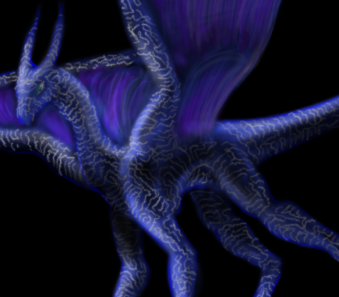
This was the traveler, lying on his side as he faced the water. His body was covered in tiny, dark-brown scales, shading toward a rusty red on his stocky chest. Long, wiry limbs ended in clawed hands and feet, and a long, heavy tail stretched out from the base of his spine. Two vestigial wings, too small ever to bear him in flight, emerged from behind his shoulders. His neck was long, and terminated in a crocodilian head, wide and flat but with a narrow muzzle, beneath which dangled a bright red dewlap of loose skin. His eyes were a dark amber around slit pupils, shielded under increasingly heavy eyelids. Around his neck he wore a necklace of polished bone beads; a short kilt of woven grass hung from his waist, and just above it, crudely lashed in place with a length of twine, was a blood-soaked bandaged on his side. Beside him, where he had laid it, was a bundle containing what meager store of food he had managed to gather as he had hurried away from the wreckage of his tribe’s camp.
He dozed for some hours, lulled by the sound of the stream, before dragging himself into consciousness. He undid the twine, removed the makeshift bandage, and glanced at the wound beneath his ribs, grimacing at the sight of the blood still dribbling from it. He hauled himself to his feet, swaying slightly, and glanced around the streambank. No softseed here; too stony for it to grow.
He picked up his bundle and shuffled downstream until he came to a place where the land flattened out and the stream formed a shallow pool. He smiled grimly at the sight of what he sought: tall grasses growing at the margin of the water, with greenish-yellow orbs clustered near the top. He waded in and collected some of these, stowing most in the bundle, and broke open the last few to reveal a matted white fluff inside; these he worked into a broad wad that he lashed back into place over the wound. As he stood there, a fish swam past his leg, and his long arm flashed down into the water and caught it before it could move away.
He waded back onto shore, stuffing the fish into his mouth. He would have preferred it cooked, but he had nothing to cook it with, and in any case was hungry and weak enough not to spurn a gift from the spirits of this place. The sac beneath his muzzle inflated briefly, and fluttered as he emitted an unsteady but resonant thrum of gratitude.
But the brief moment of hope passed all too soon, and he sank to the ground amidst the reeds. His tribe was gone; he was still bleeding, and there was no one with a healer’s skills to tend his wound properly; he had all too little in the way of food, and all too little strength with which to gather more. A fish and a new bandage were welcome, but they would not carry him far. Perhaps, he thought, he should stay here for a while – perhaps there was. Surely he was far enough away from the raiders by now.
A raindrop splattered on the top of his head, reminding him that finding some kind of shelter might not be a bad idea either.
But later. Just now, he had to rest. Reaching up, he pulled down the tops of a cluster of the nearest grasses and pulled them over him, awkwardly tucking their ends under his body as he lay down; it would not keep a heavy rain off him, but it might spare him a casual soaking. His head dropped to the ground, and, in spite of the increasing drumbeat of the rain, he fell asleep.
He lay there for hours. He never heard the rustling of approaching feet, nor the muttered words; and the hands that seized him wakened him only briefly before a carefully-judged rap to the skull with a cudgel returned him to unconsciousness.
—
At first, he thought had had been captured by the same raiders that had attacked the camp, that they had followed him. But those, like their victims, had been lean and ragged; they had attacked and killed out of desperation rather than malice. But the band that led him, tethered by the wrists, toward the north, were much different; purposeful, well-fed. And, indeed, well-equipped; they had weapons and tools of bright metal, such as he had only ever heard about.
And, surprisingly, they were not overtly hostile. They were not friendly, either, not by any means, but they were… hospitable in a businesslike way, if that word could be applied to captors acting toward a captive. They fed him well, better than he had been fed in some time. They had cleaned out his wound with some kind of strong-smelling liquor.
He recognized the language they spoke among themselves, but what they said gave him little information. They spoke of a place called Tebech, which seemed to be a place of trade; on the sledges they dragged behind them, they carried what he assumed to be their trade goods - a few animals with fine furs, some baskets of semiprecious gems - but this did not explain what they wanted with him, and they did not seem inclined to answer his questions. His empathic sense told him that they felt they were doing an unpleasant but necessary task with respect to him, but he had no idea what.
Their pace was not hurried, but his injury slowed him down and the loss of blood had made him weak, and each time they made camp, he felt he had been pushed to his limit. When they made their seventh camp after a long vigil - which had involved traversing a rocky ridge via a maze of narrow ravines, manhandling the sledges all the way - he half-sank, half-toppled to the hard ground, and lay there only dimly aware of his captors' words.
“He's not going to be much good to anyone if he dies on us on the way there.”
“He's not much good to anyone as it is. We should've just patched him up and set him loose.”
“The spirits understand the motives of need. He needed help, we needed something extra to take in. At least he's not dying from a wound gone bad. He may have it tough now, but he's young and strong, and he'll have a chance to rest once we hit the river.”
—
He did not remember falling asleep. When he awoke, one of his captors - a woman with golden-brown scales and a prominent throat sac, who seemed to be one of the group's leaders - was carefully examining his wound. He remained still, but perhaps the change in his breathing alerted her, because she felt moved to speak quietly. “You're still healing, slowly.”
It was not a statement that invited reply. Nonetheless, he tried. “Why are you doing all this?”
The woman stood up. “You had a need. So did we. …rest while you can. We'll stay a while longer, give you a chance to get some strength back. In another march or two we'll make the river - there'll be a barge there that will take us downstream, and we can all rest.”
“Barge?” The word was an unfamiliar one.
“A… large raft.” She turned to go.
“Wait. Will you not tell me what's going on? Aren't I owed that much?”
She turned back, unsurprised but unamused. “Owed? You may well owe us your life.”
“You have a need,” he said, casting her words back at her. “So do I.”
There was a long, tense silence as they stared into each other's eyes. Some of the others, close enough to notice the exchange, observed nervously.
At last, she inflated her throat sac and released a loud sigh, then sat back down.
“We are gatherers. We bring goods to a place called Tebech, where the four-legs dwell. They are callous and clumsy, but they have the knowing of how to make many useful and beautiful things - and giant rafts bring them other goods from far away. They are willing to trade some of them for the things we bring. But in recent turns, our harvests of game and pelts have been… scanty. We had despaired of receiving enough to make our way.”
He nodded cautiously. He knew it all too well; the misfortunes of his departed tribe had been due to the same scantiness.
Something extra to take in…
He spoke quietly. “And so I am a… harvest?”
She avoided his gaze. “The four-legs in Tebech find us useful. We are stronger and more agile in the arms than they are, we have a longer reach. They find us good for certain kinds of labor. But since not many of us will come to them willingly… they will trade much to have people brought to them. We had not thought to make that kind of trade, but… when the spirits led us to you-”
“I'm to be traded? Like meat?” he interrupted. “How long will I be meant to work for these… four-legged things you speak of?”
“That,” she replied quietly, “is not up to us.” She rose to her feet, and turned again to go.
“Will you at least tell me your name?” he called after her.
“I would not have you curse it,” she said, speaking over her shoulder. “And do not tell me yours; I would not wish to mourn it.”
—
There was a sort of permanent camp at the river. The barges, as the woman had called them, came and went, coming from downriver and returning the same way. They embarked on the next one that had room, alongside another party carrying bundles of herbs and spices.
There had always been legends of four-legged ogres that dwelled over the horizon, and sometimes travelers had passed by claiming to have spoken with those who had seen them. He, like others of his tribe, had laughed and thought them gullible, and the woman's invoking of them as trade partners had sounded absurd. And now, for the first time, he saw them in the flesh, and gaped in astonishment. They shambled on all fours like beasts, save when they needed to use their forepaws as hands; their muzzles were unnaturally broad, their wings oversized (one of those manning the barge flew, even as he watched!) and their scales sometimes of ludicrous colors. And most disturbingly of all, he sensed no feelings from them, none at all. Had they no joys, no sorrows? Had they no souls?
“Watch them,” the woman told him, as the shores of the river passed by. “In their own fashion, they laugh, they weep, they roar. But they find it unseemly to bare their feelings directly, and so they conceal them from each other.”
He found it rather horrifying to think that someone might choose to live in such a way. Under other circumstances, he might have pitied them.
As he regained more of his strength, he finally began to feel as if he might be able to attempt an escape. But he felt compelled to dismiss the notion almost as soon as it had occurred to him; they were surrounded by water, and his people were not skilled swimmers even with their hands free; with his bound as they were, he would not make it to shore. In any case, he had watched the four-legs diving for fish, and it would not take long for them to catch him.
He proved to have little time, in any case. The current had carried the barge swiftly along the river to its destination, and soon they were surrounded by the bustle of Tebech. He had never been in a permanent settlement of any sort before, but this one, a patchwork of stilted wooden buildings and platforms raised above the marshy islands of the delta, could have held a dozen or more tribes. There were four-legs everywhere, and despite the seeming sense of normality in their business, their blank empathic impressions and peculiar smell were curiously upsetting.
He was marched off the barge and along wooden walkways until he was brought to a wide platform, apparently the place where trading was done; everywhere were people and four-legs haggling, arguing, discussing. The woman who had spoken to him along their journey murmured quietly to a four-legs standing near a series of upright posts, to which other people, men and women in their prime or in their youth, had been tethered. The four-legs inspected him carefully, said something to the woman, and gave her a carved token; then she and the others dragged their sledge away to sell the rest of their merchandise. She did not look back.
—
“What about this one?”
The slave trader looked askance at Tōlik. Between her muscles and the definition of her status-markings, she was an intimidating and commanding presence, but business was business. “On the kind of budget you're talking about?”
“Don't tell me it's worth more. Look at it. Skinny, wounded. You should be paying me to take it off your hands.”
“It's young, got good muscles. Just needs feeding up a bit, that's all.”
“Needs to be propped up a bit, more like.”
They spoke in Imperial, which the native clearly did not understand; he glanced back and forth between them, eyeing them warily. The slave trader caught one of his looks, and lashed out at his face with his tail.
“Not kept well, either,” Tōlik added promptly, “not with you smacking it around like that. You can't expect to make me a sale, behaving like that.”
“Pah! I barely touched it.”
Tōlik shook her head stubbornly. “Honestly, I don't see the point. This muckhole used to have promise, but I didn't bring my ship all this way just to get cheated on slim pickings.”
The slaver grimaced as she turned away. He was not the most civic-minded man, which would have been a major drawback in his line of work, but he was keenly aware of the economic realities. Ships like Tōlik's were what kept Tebech afloat, and it would be bad for business if they stopped coming. She might be willing to pay only barely more than what he'd gotten for the native, which was bad; but her deciding not to come back would be worse.
“All right, look-”
Tōlik turned. “You said something?”
“Throw in a bottle of that liquor you carry around and you can have the wretch. Then at least I can drown my sorrows.”
She gave him a crooked grin. “I think I can live with that.”
—
Though his bindings had been loosened, the slave looked bewildered. All told, Tōlik couldn't blame him. He stared around at the ship, bobbing up and down on the waves; the rigging, with the takmar of the crew swooping around it unfurling the sails; and above all, at the land opening wide on either side to reveal the vastness of the sea. Every time he looked at it, he seemed to drink it in; he breathed deep of the salt smell, as if it cleansed him.
She knew the local trade language well enough, and spoke to him in it. “You've never seen the sea before, I take it.”
He flinched at being addressed, and replied, “I have only heard of it.” He looked her in the eyes. “What is to become of me here?”
“Work,” Tōlik replied. “I'm not normally in the market for slaves, but some of my crew decided to get themselves killed while they were ashore. No skilled sailors around to replace them, but at least you were cheap. We can teach you which ropes to pull and when, I imagine.”
Cautiously encouraged by her conversational tone, he asked, “And I will be doing this forever?”
“Oh, no.” She smiled. “For a few turns, until we get back home. The work I get out of you should be worth the price. And when we get there - well, it isn't allowed to own another person there, even one like you. You'll be free to go, if you wish. Of course, if you prove to be good at it and decide you like it, maybe we could come up with a more… equitable arrangement in the future.”
He found himself turning to stare back at the fabled sea. He, and his new master, and the great raft on which they rode, all moved deliberately out into that hungry expanse, and it would eat them one way or another - maybe in its depths, maybe in its boundless horizons. But the prospect of facing it did not seem quite so bad as it ought.
Though Tōlik did not emit any feelings that he could detect, she could read them, and his were open to view. She said, “Yes. It's right to fear it and to respect it. But there's something there to embrace.” She jerked her head toward the hatch. “Get below, get fed, get some sleep. When you wake, you're going to start learning your way around a ship. And at least some words in a decent language.”
She began to turn away. He hesitated, then called after her. “What is your name?”
She paused. “Tōlik.”
“And what are your people called?”
“Takmar.” She looked back. “And you?”
“I am Chrgadz.” He smiled, tentatively, in the way of one who had not smiled in a long time. “And I am orghysh.”