Table of Contents
Extrinsics
Outside reality as mortals know it lie realms beyond their ability to comprehend. Things such as matter and energy, space and time, have no meaning here, and a mortal visitor - should one survive at all - risks becoming insane by the time they return to reality.
Nonetheless, the Outside has inhabitants, and these unfathomable beings might classified together - if enough of their common nature were indeed known - as the Extrinsics.
Living outside the bounds of the universes and their physical laws, the Extrinsics would be almost omnipotent to a mortal viewpoint, able to bend reality to their whim and potentially shackled only by others of their own kind. Those mortals who become aware of them often call them gods, though they far outclass other beings of that name that are bound within universes.
Anatomy and physiology
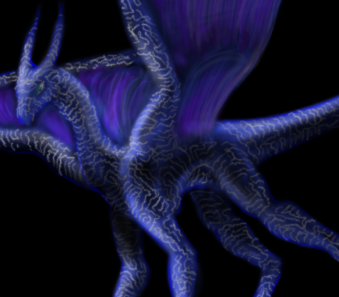
Extrinsics may, if they wish, manufacture material bodies for themselves, so that they may interact with mortal universes without attracting attention. These constructs, however, do not house the consciousnesses of their creators, nor does their design reflect their creators in any way other than, perhaps, personal taste. They are, to the Extrinsics, something like a remotely-piloted drone would be to a human operator, though far more complex and sophisticated.
On those occasions when a mortal appears in an Extrinsic's realm, their mind will generally struggle to make sense of its surroundings. But should they succeed, either with or without their host's help, the presence of the Extrinsic will generally be translated in the mortal's mind to a sensory approximation of its characteristics - very often in the shape of some roughly equivalent mythological figure, if one exists, as this is the mortal's most convenient “shorthand” for the being they are in contact with.
To ask what an Extrinsic's “true” form is would be a meaningless exercise, since they have no inherent physical existence. They might best be described as living concepts or sapient universals, self-aware aspects of the very fabric of existence.
It is important also to note that, while they are treated here as separate individuals and interact with each other in ways that would suggest individuality to the mortal mind, they are far more connected to each other than mortals generally are, and might be more accurately understood as very autonomous portions of the same thing rather than separate beings.
Senses and perception
Within the context of the Outside, the Extrinsics have nothing to sense but their own kind. Since they have no physical existence, their only mode of perception might be considered a form of psionics; they can sense the presence and thoughts of other Extrinsics.
It is not possible for one Extrinsic to actively prevent another from reading its thoughts, though particularly intense scrutiny is considered impolite. There is also no guarantee that what is seen can be understood; the less similar two Extrinsics are, the more incomprehensible they are likely to find one another.
With respect to the mortal realms of the Froth, the Extrinsics are all theoretically omniscient. From their outside viewpoint, they are able to observe any point or region in space or time at any level of detail required. In practice, however, their perception of any given universe tends to be reductive and statistical; they may understand how things are put together and the laws by which they operate, but traditionally have had difficulty with the nature of emergent properties. The realization that mortal life and sapience constituted their own phenomena, in particular, was one that was slow in coming.
Many Extrinsics, particularly those of limited scope, only pay attention to that aspect of the Froth that concerns them the most. But even those that take a more general interest often struggle to gain an impression of what existence is like on the inside of a mortal universe, lacking as they do the senses, bodies, brains, and life histories of mortals.
Biology
Genetics and reproduction
The first two Extrinsics, and the most fundamental, were Order and Chaos, born directly from the fragmenting of the Whole. All other Extrinsics are born either directly or indirectly from these first two.
The creation of a new Extrinsic is essentially a process of subdivision, in that some of the nature of the “parent” - or parents - is taken and put into the “child”, being lost or diminished in the parent in the process. This act is quite deliberate, and usually carefully thought out, along the lines of making a dish from a complicated recipe. It is remembered by the Extrinsics that the first child of Order and Chaos was not as well-built as all that, and what happened as a result.
While in theory there could be Extrinsics many generations removed from Order and Chaos, in practice this is limited by their own nature. Because each Extrinsic is only a subset of its parent, a member of each new generation will, on average, be less capable, and less understanding, than that of the previous one. While this situation can be improved upon by the participation of multiple parents, the fact remains that, beyond a certain point, the “child” of an Extrinsic is so limited in scope and awareness that it cannot be considered more than an aspect of its parent.
Add to this the fact that Extrinsics must put something of themselves into each of their children - being duly diminished in the process - and it is perhaps understandable that not only the number of generations, but also the total number of Extrinsics, is relatively limited.
The Extrinsic's nature does not change through its life, except when it is subtracted from through reproduction, but its understanding may. In its “youth”, an Extrinsic will gain a certain amount of knowledge from its parent or parents, though its understanding may expand thereafter throughout its life. How well an Extrinsic learns, and what it is capable of learning, will depend on its own nature.
Development and life history
Once created, an Extrinsic remains in existence, gaining in knowledge but not aging. It is theoretically possible to bring the existence of one to an end by deconstructing it and reabsorbing it - essentially reversing the process by which it was made - but this would be an agonizingly difficult task even with the agreement of both the Extrinsic and its “parents”; it has never been attempted.
It is generally considered that only Hunger would have both the inclination and the ability to “eat” an unwilling Extrinsic, though Order and Chaos almost certainly have the capability.
Should the Whole ever be reunited, the Extrinsics would presumably all be brought to an end in their present form, but whether they would be dead is more of a philosophical exercise than anything.
Ecology and habitats
While the Extrinsics can, and usually do, have some presence within the Froth, their beings are without exception housed Outside.
Since the Outside contains nothing but the Extrinsics themselves, it would not be too far a stretch to say that the they are, in fact, their own environments. While there may be a subjective feeling of “distance” between one Extrinsic and another, this is largely a function of the differences between them along various dimensions of their natures; there is no physical dimension between them.
Each Extrinsic may, for its own reasons, surround itself with constructs and realms of its own devising. These are, however, entirely dependent on their creator's will; they are, for lack of a better term, thoughts or imaginings, part of the Extrinsic's inner life. A mortal visitor to an Extrinsic's realm has essentially gotten into its head, though what they see or perceive there will depend on how well they parse it and whether or not the Extrinsic helps them do so (and whether they survive long enough to get out).
Society
Structure
The first Extrinsics, Order and Chaos, as the ultimate progenitors of all the rest and the most powerful, are the highest authority among their kind. In practice, however, they serve more as arbiters than rulers; the Extrinsics largely engage in their own individual pursuits, and while they talk constantly among each other, they rarely have need for organization - usually if they are cooperating on some larger project. In any case, most Extrinsics settle disputes adequately well between themselves.
While conflicts between Extrinsics' spheres of influence are common, they are most often considered as contests or games rather than hostilities. The outcome usually causes the transfer of what might loosely be called political capital from the loser to the winner, the amount of which is proportional to the importance of the game. This capital, in turn, can be spent in order to induce other Extrinsics to cooperate with the spender's schemes, though the earlier the generation of the Extrinsic - and the more powerful it is - the more expensive it is to “hire” them.
Naming conventions
The Extrinsics do not have names in the traditional sense. They can hail, and communicate with, each other directly; and they can recognize each other by one's own unique nature, which is one with its identity.
In mortal languages they are usually - as they are here, in English - referred to in a way that reflects the dominant facet of their natures, though this is usually a major simplification. This, of course, only applies to those situations where they are not already mistaken for the deities or beings of mythology.
Gender conventions
Perhaps unsurprisingly, given their lack of physical bodies, Extrinsics have no biological sex; nor, indeed, do they have any feature that might correspond to gender identity in a way useful to mortals. The latter, therefore, generally assign them genders (and corresponding pronouns) according to their perception of their traits or their identifications in mythology.
Relationships
The web of relationships among the Extrinsics is, perhaps, most analogous to an extended family. Each Extrinsic will be closer to some of its fellows than others, and like - or dislike - some more than others. But they are expected to be, at a minimum, civil with each other when they interact.
While the analogy to the parent-child relationship can be taken too far, it is nonetheless the case that an Extrinsic is more likely to be on friendly and cooperative terms with those that made it - its “parents” - and, to a lesser degree, its parents' other creations - its “siblings”. Partly this is due to the similarities in nature shared by all of them, though in the case of the parents it will also be due to the shared experience of the young Extrinsic's tutelage.
The process of creating a new Extrinsic is a relatively technical, passionless, and even businesslike one; if multiple creators are involved, it is advantageous if they work well together, but the resulting partnership has more in common with a team of collaborators in a workplace than a marriage or other domestic partnership, and their feelings toward each other - even at their deepest - can best be described as platonic.
For those Extrinsics that bother to study mortals at all, the ideas of love and physical attraction are among those aspects of their behavior that are hardest to understand. It is said that while Chaos has spent some effort, walking among mortals, trying to experience them directly, only Remembrance has any real grasp of their importance.
Taboos
Most of the taboos that the Extrinsics have either relate directly to Hunger, or were inspired by it.
Order and Chaos will be the keepers of Hunger, and only they may interact with it. No one else may speak to it; no one else may feed it, and must give the universes intended for that purpose to Order and Chaos; and, above all, no one else must attempt to free it.
So that another case like Hunger should not arise, any new Extrinsic created must be balanced in its design, and Order and Chaos must approve of it before it can be allowed independent existence.
History
Though time is a different thing in the Outside than it is in the universes of the Froth, there is duration of a sort, and a history.
It is said by Order and Chaos that they were born from the shattering of the Whole, the singularity of all things, as a result of their strife. Separated from each other, they sought to return to the unity that had previously been, but to reassemble the smaller fragments of the Whole - the bubbles of spacetime we call universes - into something that could bridge the gap between them proved to be an arduous task.
To help them with their task, they each used some of their own nature to make their first child, who they called Hunger. Hunger was the distillation of their desire for incorporate everything back into oneness, and it was capable of consuming universes and refining them within itself to make them more suitable for the reconstruction of the Whole. But being the first of the creations of Order and Chaos, Hunger was a flawed creation, composed of too pure a nature; while Hunger was what it was, it was too much of what it was, and Hunger was increasingly unsatiated.
Eventually driven mad by its own nature, Hunger sought to recreate the Whole within itself by devouring all else - at first only universes, but, once it became powerful enough, Order and Chaos as well. The nature of the conflict that ensued was unclear, but it ended with Hunger being restrained - not ended, for Hunger had grown beyond their ability to reabsorb it into themselves, but prevented from consuming universes other than those purposely fed to it.
Order and Chaos were distraught at what they had been forced to do, and blamed each other for Hunger's fate. But, eventually, they began to interact again, spurred on by their gradual realization that the complicated thing called Life, puny and messy though it was, might one day prove to be the key to their desire for oneness, and the antidote to their child's madness.
Having learned from their mistakes, they created new offspring with more balanced natures, the first of which - Remembrance - had as its task the understanding of mortals and their lives.
Relations with other species
The fundamental linkage of the Extrinsics with reality as a whole means that their actions and decisions affect mortals, and their realms, very nearly all the time. That said, most Extrinsics do not pay attention to mortals, if at all, except in the aggregate, as peculiarly persistent and active collections of chemical reactions (or physical states, or meme-complexes, or something else, depending on the form of life). They likewise see no advantage in attempting to communicate with them.
Those Extrinsics most concerned with mortals are Remembrance, who rarely communicates with mortals until after they die, and Chaos, who enjoys communicating with mortals while alive but will tell them whatever it finds most useful or amusing at any given time. Add to this the fact that many mortals would be predisposed to react to stories about extradimensional beings by either disbelieving them or misunderstanding them, and it is, perhaps, not surprising that mortal knowledge of the Extrinsics tends to vary from the nonexistent to the severely garbled.