Table of Contents
Amberworld
Background
The emergence of Avishraa resulted from a conjunction of two factors. One was the existence of free, ad-supported messageboard provider InsideTheWeb (ITW), which operated from 1997 to 2001, and which made it disturbingly easy for anyone to create, customize (in a basic way) and post on a messageboard, or even many messageboards. The second was Shyriath, Avishraa's creator, first obtaining Internet access toward the earlier end of the same timeframe, while he was in high school.
Shyriath vaguely recalls searching for promising locations for fantasy roleplaying, and hitting upon, as one of them, an ITW board called Amber's Place. Shyriath never did become fully aware of its history before his arrival, but at that time, being a spot for peacefully roleplaying any of a variety of fantasy creatures - particularly dragons - it had begun to develop into a kind of hub for other, less-active boards that functioned as various characters' private realms.
 Shyriath's character was a magically-powerful but physically-pathetic dragon, also named Shyriath; the name, in fact, was created for the character, since up to that point the person behind him had not previously required any kind of username. Those powers that the character had were mostly telepathic, but the details were not consistent and shifted in accordance with the player's needs and/or whims. However, feeling a need to give the character some background, Shyriath gradually built up a picture of where he was from and why he'd come to Amber's Place, and the result was the Avishraa setting.
Avishraa consisted mostly of background information, and very little if any of the world was ever directly seen in any of the continuity, though it remained a persistent influence. Shyriath's ITW board, titled Citadel of Life, was set in a kind of living building complex that had been magically transported from Avishraa to the same world (or plane, or reality, or whatever it was) that Amber's Place, as well as the private domains of the other players that Shyriath had become familiar with, all resided in. Several of the threats the character faced throughout the character's career emerged, directly or indirectly, from there, especially Zadireth, his eternal nemesis.
Shyriath's participation in ITW, however, declined as 2000 approached, and so did that of much of the rest of the community. In Shyriath's case, this had much to do with the end of high school, applying to colleges, and getting a part-time job. Given that many of the other players were in a similar age bracket, this may have been the case for them as well, though Shyriath had noticed, on wider-ranging sojourns throughout ITW boards, that many other communities seemed to be suffering from a similar problem. Certainly, a drop in ad revenue was cited by ITW as the main reason for shutting down in 2001, and may have been linked to the rise of EZBoard at about the same time.
Many ITW users fled to EZBoard as the main free board provider left standing. Shyriath was ultimately among these, though he did not immediately make the jump; what was left of the community had effectively been scattered by ITW's closing, and Shyriath had not known where most of the familiar players had gone. He eventually joined two players, Racky and Wyvr, at a board created by the latter, named 'Amberworld' in honor of Amber's Place. There, the characters of Shyriath and Zadireth were developed and given more complexity, Ilirith was introduced, and several more years of fun were had - on a smaller scale than on ITW, more self-contained and slow-burning, but easier to keep up with through Shyriath's college years.
The EZPlague of 2005, in which a hacking attack caused thousands of boards to be lost of corrupted, affected Amberworld as well, and in a sense marked the beginning of the end of the RP. While it continued for several more years, the loss of so much work demoralized the participants, and combined with lack of inspiration and various personal concerns, the RP finally trailed off in the late 2000s, marking the end of the continuity
Over the course of about ten years, the idea of what Avishraa was like, how it worked, and the rules its natives had to abide by, all changed with repeated reevaluation - some well-thought-out remedies to earlier flaws, some on-the-spot decisions that added convenience to an RP session. What follows here is broadly a picture of what it was like toward the end of the process, focusing on the most stable parts.
Worlds and geography
Avishraa
 Avishraa is, then and now, the large, habitable moon of a gas giant, previously called Telvahr (the equivalent of current Kastun). At the time, the implications of this for day length had not been thought through, though the effects of tides had, and there were instances where Avishraan characters, introduced to worlds where tidal pull was not so strong, felt this as a curious absence.
Avishraa was in a star system centered on a close binary star, Shar Avikael, the Eyes of Avikael, with the planets orbiting around both of them; these were Sharii, the Eye of Wisdom, possibly a K-type subgiant in the early stages of expansion, and Shayel, the Eye of Knowledge, probably a G-type main sequence star. Telvahr was one of six planets (and an asteroid belt); there was life known to be found in Telvahr's atmosphere. At least two other major moons of Telvahr were identified inside of Avishraa's orbit: Irthruun and Havthruun (the First and Second Moons).
While Avishraa's status as a habitable moon has not changed, much of the rest of the solar system cannot be assumed to be the same. Though most of it has not been determined at all, it is known that the system has only one sun, Mikurmiya. This has a lot to do with Shyriath's desire to ensure that Avishraa would be realistically inhabitable; he felt that having both a binary sun and a habitable moon around a gas giant would introduce too many complicating factors.
(On a related note, Avishraa is also now far enough away from Kastun that being able to feel tides in one's body is rather unlikely, if indeed there was a point where that wasn't the case. The distance is far enough to avoid getting fried by the planet's radiation belts but close enough to be shielded by its magnetosphere.)
Aside from a few specific locales and features, little was known about what Avishraa was like, except that it was, on average, warmer than Earth and mostly tropical, with little land existing poleward of either 50° line of latitude. Some of this remains true today; Avishraa is, on average, warmer at sea level than Earth is, and its sapient species all originate, and thrive most easily, in warm climates.
Sahvarr River
The Sah'varr River had the largest watershed of any river on its continent, and was one of the largest (though not the largest) on Avishraa. Most of its tributaries arose in a mountain range running northeast-southwest along the spine of the continent, and flowed generally southward toward the ocean.
The upper reaches of the valley were dominated by dramatically uneven, even precipitous, terrain. High rainfall resulted in numerous fast-flowing streams and brooks in deep, narrow gorges; although most led to the mighty Sah'varr in the lowlands, there are also numerous enclosed watersheds where the steams feed into high-altitude lakes. The temperatures were cool enough in the upper valley to maintain a temperate, or in some places even alpine, climate, despite the low latitude of the region. The region was considered poor territory by Avishraans, uncomfortably cold and difficult to traverse, and there are relatively few settlements; on the other hand, this same isolation, and the abundance of fish and game in the larger lake valleys, long ago attracted the Chosen to the area, and both Davir Sria and Davir Kaea established themselves there.
As the tributaries descended from the foothills into the lower valley, the climate turned increasingly warm, dominated by rainforests. The river, swollen from the input of its tributaries, followed a wide, twisting course to the ocean. Though flatter than the upper valley, the lower valley nonetheless remained dotted by numerous table landforms; this was particularly true in the western periphery of the watershed, although several particularly erosion-resistant examples lined the river itself, resulting in rather spectacular gorges. Major Avishraan settlements tended to be based around the tablelands, due to their excellence as natural defensive points and their high concentration of caves.
While the Sahvarr has been placed in a more detailed context, relatively little about it has actually changed; it remains exceptional both in its size and as the region most densely populated by the takmar.
Udunshraa
 Udunshraa, the Citadel of Life, was the home of the Davir Sria. It was, in effect, a small city, built around a kind of source of pure order that manifested as an orb of white light, shimmering in innumerable patterns. Udunshraa housed only Srians because Kaeans found it to be repulsive; the reverse was true of Udunneyaa. When Davir Sria and Davir Kaea had to meet, it was generally outside the walls of either.
 Shyriath described Udunshraa as being alive, a fact that resulted in its Thuban depiction as a kind of giant, inhabitable organism (which, he admits in hindsight, was a much cooler idea - and one that wasn't entirely outside Srian capabilities to implement). However, what was originally meant was simply that it had a kind of consciousness and magical power of its own, capable of reconfiguring itself and of responding to commands and requests. Physically, however, Udunshraa consisted simply of buildings and walls, though their specific design owed much to Srians' penchant for order and symmetry.
On Avishraa, it was originally in the highlands, away from the Sahvarr River, but was magically transported to the world containing Amber's Place. Shyriath then made his home there for a while, but eventually abandoned it before ending up in what was, on the Amberworld board, called A Nice, Green Place.
Udunshraa has no precise equivalent in the worldbuilding project; though the Citadel exists as a home for all Chosen separate from the world, there are no Srian-specific locations (though there is a tendency for Srians and Kaeans to cluster together in certain areas).
Udunneyaa
Udunneyaa, the Citadel of Death, was the Davir Kaea counterpart to Udunshraa. While the two were meant to be equal but opposite, one may gauge from the author's choice of name that his own feelings about the two were not nearly so balanced at that time.
Udunneyaa was never explored in nearly as much depth as Udunshraa; in the setting, the Davir Kaea had long since been killed or assimilated by the Hzataalar Kaea, who themselves had mostly relocated to mek'Tarae, and any Kaean characters introduced were generally from the latter. It was known, however, to be built around a source of pure chaos - equivalent to the source of pure order in Udunshraa - and to have a similar consciousness and abilities, though with a very different aesthetic.
The concept has largely been merged with that of Udunshraa into the Citadel in the context of the project.
mek'Tarae
 The Hzataalar Kaea, after splitting away from the other Chosen, established themselves on another world. Orbiting binary red dwarfs, they named it mek'Tarae (“in blood”), for the ruddy color of its sunlight.
 While the planet was habitable, with ample water and an oxygenated atmosphere, the life native to it was strange to Avishraan eyes, and while edible was small and unpleasant-tasting. It didn't help that the region the HK arrived in was an archipelago that wasn't particularly biologically rich to begin with; it was cold and rocky, and the Avishraan predilection for living underground was reinforced by this environment, since away from the surface they could live in warmer and more visually pleasing surroundings.
The HK had built a civilization of sorts across the archipelago, consisting mostly of widely spaced estates or homesteads; there were a few local capitals, mostly trade hubs or favorable sites, as well as the Great Citadel carved into Mt. Aduruth; this was their major population center and the seat of their rulers.
While mek'Tarae does not exist as it did in Amberworld within the worldbuilding project, the Friends of the Future - the forerunners of the Hzataalar of the worldbuilding setting - too have acquired a world to use as a private meeting place, which bears more than a passing resemblance to mek'Tarae's landscape. Additionally, the name of the Citadel, its general organization, and the nature of its center in Oldstone are all heavily inspired by mek'Tarae.
Species and factions
Avishraans
See also this article for more details.
The primary inhabitants of Avishraa were, imaginatively enough, called Avishraans. They were dragons, because the author liked dragons, and this broadly remains the case, because he still likes dragons. After some internal debate about the possibly clichéd nature of this choice, he has long since come to terms with it and graciously invites any others with similar concerns to insert them into their posterior. The dergs shall not be questioned.
Anyway.
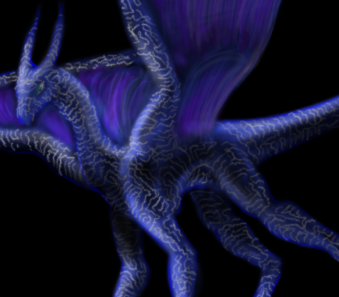
Avishraans broadly resembled western dragons, but they had a few traits grafted onto them from other sources. They were (mostly) bipedal, in a fashion similar to dromaeosaurids, though they frequently rested their weight on all fours. A trait of theirs that appeared to be at least somewhat original was an elongated limb segment on the forelimbs and wings; these were an attempt to “even out” all the limbs, since it vaguely bothered the author that digitigrade legs, with their lengthened metatarsal bones, were not matched by similarly lengthened metacarpals in the arms and wings. When the time came to turn the Avishraans into the two takmin species, the takmar and the xtauh, Shyriath had decided that the lengthened metacarpals looked silly and removed them. The takmins are now quadrupedal when traveling quickly or for substantial periods, though they will stand and walk on their hind legs if carrying or wielding something with their forelimbs (this is particularly true in combat).
Some traits appear to have been influenced by Pernese dragons, including multifaceted, color-changing eyes, names ending in -th, and antennae, replacing external ears, visually derived from Pernese headknobs; possibly also falling into this category was the idea that Avishraans were by nature at least somewhat telepathic. The word “appear' is used in the previous sentence because the author honestly does not remember consciously thinking about Pernese dragons at the time, but for there to be that many parallels purely by chance beggars belief. This is especially true since he had read most of the books and had fond memories of them; since the similarities struck him as obvious when, much later, he finally noticed them, he could not honestly expect anyone else to believe they were coincidence. The faceted eyes were later dropped in favor of more catlike, vertical-slit pupil eyes, but the antennae remained, and so did the -th ending, at least in one language family. Most members of the species were downgraded from 'telepath' to 'empath'.
They came in a wide variety of colors, which were loosely based on those of the metallic and chromatic dragons of D&D; these were essentially treated as racial groups and individuals tended to find those of their own color more attractive and trustworthy. Mixed-color pairings were known, but children of such parents would be either one parent's color or the other (or more rarely a grandparent's color, if multiple generations of mixed couples were involved); there were no mixed-color individuals. The takmins still come in a wide variety of colors, but the genetics of color inheritance are more complex; not only can a child turn out to be a color between those of its parents, but even startlingly different than either of its parents. While both species have racial groupings, they are only loosely affiliated with scale color and are more strongly identified with body shape.
Avishraans originally had a slight tendency toward matriarchy, but on the whole the sexes were still fairly balanced, and kings and other male leaders were known - see Kalnath, the title character of the Kalnassai. Couples tended to be long-term and monogamous. This was one of the more radical changes for the takmins, as both species became strongly matriarchal and tending toward polyandry - indeed, there were many more males than females to be had. Mostly this was because the author found it interesting to experiment with and work out its consequences.
The language they spoke will have no direct parallel in the worldbuilding project, but its vocabulary has been, and probably will continue to be, pilfered for contributions to the Imperial language and its predecessors.
Avishraans were social beings and tool-users, and were capable of technological civilization; Shyriath wanted his dragons to be a bit more than the clever savages traditionally presented in fantasy works. They had advanced far enough to form what were essentially medieval city-states, each dominated by a particular color, and frequently and with some enthusiasm warred against their neighbors. Though color-dominance is no longer a factor, in most other respects this picture has only been expanded upon rather than substantially changed; both takmin species have a stronger sense of territoriality and aversion to clustering together than humans do, which makes centralized organization above a given size relatively difficult. In the present day of the project, medieval city-states remain the norm, at least for the takmar; the xtauh are less technologically advanced, less willing to submit to hierarchical authority, and generally live in more marginal environments, and so are more of a mix of agricultural city-states, transhumant ethnic groups, and raiders, most somewhere between the Neolithic and the Bronze Age.
The Avishraans were not extremely important in the Amberworld setting in and of themselves; they hardly left Avishraa itself, so they were never encountered in the RP and their doings were not relevant to most of Shyriath's characters. Their importance lay instead in being the species from which those individuals retroactively called the Chosen were derived. Being Chosen was an inheritable condition rather than a biological clade, in that the Chosen did not differ in any appreciable genetic way from other Avishraans and could interbreed with them without issue, but were very different physically and behaviorally. Nearly all Avishraan characters making an appearance in Amberworld were Chosen of one kind or another. While ordinary takmar and xtauh are given a much bigger spotlight in the worldbuilding project - taking place as it does on Avishraa itself, where they make up the bulk of the population, it could hardly be otherwise - in a sense, the Chosen, and their effects on the world, are still at the heart of the whole business.
The Chosen came in a number of delicious flavors, which shall be dealt with separately below.
Davir Sria
The Chosen were, from their beginning, divided into two kinds: those aligned with Order, and those aligned with Chaos. The former were the Davir Sria: approximately, the “Brotherhood of Order”, though the noun davir could also be translated as “community” or “league”; the sense is that of a group banded together for mutual support. Though originally applied only to the group, the term also came to be used for individuals as well.
All Chosen had the capability to perform magic, and were the only Avishraans who did. This was accessible in four kinds, labeled Body (the ability to affect physical matter; most usually living things, but very rarely the inorganic); Mind (telekinesis and any telepathic abilities more invasive than simple communication); Energy (the ability to affect and direct energy such as heat, light, etc.); and, most rarely, Dimension (the ability to manipulate the fabric of spacetime - teleportation and related abilities). In theory each individual was limited to no more than two (and usually only one) of these, but in practice this rule was bent significantly in RP. Chosen gained some of their abilities in childhood, but did not become fully empowered until experiencing a physiological event called Second Manifestation. This almost always occurred during adolescence, though its exact timing depended on a number of psychological and environmental factors. The results, especially when experience under stress, could be spectacular:
It felt as if something had slammed into Shyriath's mind. Blood roared in his ears, red clouded his vision. He felt as though part of his brain had been ripped away, taking his memories, his personality, his very life with it. He felt sick, so horribly sick. He wanted to die, he was so miserable. Shyriath knew, without even looking, that Kyprath was dead, the deeply entrenched mindlink they'd shared gone, and bits and pieces of Shyriath himself with it. And he knew also that all the others felt exactly as he did. Time seemed to speed up in Shyriath's perception. He felt two more wrenches as Navrinath and Shemrath died, though he could no longer see or hear anything but his pain. And yet, though he thought his torture had reached its limits, with each wrench his pain only increased. And then, there was one final jerk as Haazrath was torn away, though Shyriath thought he could hears two words come from him before the mindlink was uprooted… ”…the jewel…“
And then he was alone. Emotionally, mentally, he was alone, without the support that all of his kind wanted and needed to remain alive. The realization suddenly brought anger to him. Suddenly, power seemed to flow through him, power that he had never felt before. He remembered what he had been told about his second manifestation, realized what he was capable of, then as never before, and uttered a single cry, with his mind as well as his voice, even as he sensed his captors coming to kill him, as they'd done to the rest…
“IT IS YOU WHO SHALL DIE THIS DAY!” He felt the power rush out of him, felt an immense heat blast away at his seemingly distant physical body… and then silence…
The magical ability of a Chosen, however, came at the price of physical deformities. They were smaller than standard Avishraans, and suffered frequently from cancers, abnormalities of organs and metabolism, and chronic illnesses. Black, growth-like patches appeared on their hides, and appeared to replace their scales; receiving a surface cut in one of these areas resulted in a black liquid, though if the cut was deep enough it would be mixed with blood.
Davir Sria and Davir Kaea shared all the above traits, but they differed in their thought processes and behaviors. Davir Sria, for their part, were organized, hierarchical, and methodical, and their aesthetics favored patterns and symmetry. They also enjoyed the closeness of other minds, and almost universally formed mindlinks with friends and loved ones - these being a permanent bridging of the gulf between minds, joining them and blurring them at the edges. There were different depths of mindlink appropriate to different kinds of relationship, and although a full union of minds was not often attempted, mindlinked individuals were very often acutely aware of each others' thoughts and emotions.
The result was a general networking of the entire population of Davir Sria under one mindweb, which allowed efficient communication across the entire population, easy gauging of public moods and opinions, and the storage of memories and personalities - even, to an extent, after death.
The state of being a Davir Sria was strictly hereditary; they did not arise spontaneously, but only as children of another Davir Sria, and usually all children of one were themselves Davir Sria. The same was also true of Davir Kaea; unions between Davir Sria and Davir Kaea generally resulted in no children at all, or else ones who did not survive childhood. It was partly for this reason that there was originally no term that encompassed both Davir Sria and Davir Kaea, since despite their similarities they were effectively separate groups.
The Davir Sria were keen seekers of knowledge, and used science and magic in pursuit of ever more lofty goals, to the extent that they once created a living vessel that could carry people into space. This last project, however, resulted in a cataclysmic impact that rendered the region of both Chosen citadels ruined wastelands. This left considerable bad blood between the Davir Sria and Davir Kaea, a fact that helped lead to the formation of the Hzataalar Kaea and the near-extermination of both Davir Sria and Davir Kaea.
In the context of the worldbuilding project, much has changed. The two halves of the Chosen can interbreed, and find each other rather more bearable, to the extent of being willing to live in the same settlements; though still smaller than ordinary takmar and with a higher cancer risk, they are not necessarily deformed or sick, and the black patches are no longer a thing (they have been partly recycled as simple female scale coloration); they can occasionally arise from 'normal' parents, though most are born of other Chosen; and the types of magic available to them have been made more numerous, but more narrow.
Many of these changes were made because, although their original weaknesses were intended to balance out their magical power, it seemed to Shyriath that this only worked while they were in isolation. Wanting their incarnation in the project to be able to directly and credibly threaten takma society at large, and to survive while doing so, he felt that sheer difference in bodily size and in numbers was quite enough of a handicap to their survival, especially since they have not yet engaged in the same kind of techno-magical wonders in this setting.
Davir Kaea
Relatively little is said of the Davir Kaea here, because they did not figure very prominently in the RP; only one of Shyriath's characters was a Davir Kaea and that was a minor one. Most of them were either killed or co-opted by the Hzataalar Kaea long before, and those that were left took care to look and act like HK, lest they be discovered.
Whereas the Davir Sria were seekers of knowledge and organization, the Davir Kaea were, by and large, seekers of inspiration and expression. They had a tendency toward restlessness and, though their homes were in Udunneyaa, were more apt to go traveling in search of new sights and experiences. Many of them were of an artistic temperament, fond of making unique creations and gaining notoriety from them. Though the Davir Sria were the ones who developed the art of Writing, the worlds the Davir Kaea wrote were often the stranger and more fascinating ones.
The Davir Kaea did not use mindlinks, and had no equivalent to the Davir Sria mindweb. Fiercely individualistic, they did not enjoy the thought of being even partially merged into a greater whole.
In the aftermath of the cataclysm caused by the Davir Sria, a number of strange philosophies and cults appeared among the Davir Kaea, fueled by the trauma of the experience. The most secretive and aggressive of these, the Hzataalar Kaea, converted ever-larger numbers of their brethren to the cause, and, when their numbers were high enough, staged a violent takeover of the rest. The remaining Davir Kaea who were able to keep their sanity after the physical portion of the conversion process were careful not to show their dissatisfaction in public, and generally behaved enough like HK to pass muster; during the fall of mek'Tarae, they reemerged as a much smaller but very active faction under the leadership of Zadireth's sister Zanareth, where they spent some effort trying to wipe out the HK. Having found a way to undo the mental effects of the transformation while keeping most of the physical ones, they proceeded to quietly attempt to rebuild.
Hzataalar Kaea
The Hzataalar Kaea (“Warriors of Chaos”; singular Hzataal Kaea) arose from a group of Davir Kaea who, in the wake of the catclysm, come to two separate conclusions:
- The Davir Kaea needed to perfect the world without, by ridding it of the scourge of Order that had brought so much misery;
- They also needed to perfect themselves within, fixing their own imperfect bodies.
It was, therefore, essentially a purifying movement: both the world, and the Davir Kaea, had done themselves a disservice by blindly submitting to their situation and maintaining balance with the Davir Sria, who had, through their hubris, ultimately upset that same balance. Since the gloves were now effectively off, it was time to play to win, and win permanently.
They were bright enough not to begin by open preaching. They sounded out converts and brought them into the fold, and then started with the more technically difficult but broadly attractive goal of correcting the deformities that plagued the Chosen. This took them many years and rather uncharacteristic patience, but they ultimately persevered; they developed a set of magical processes which, when applied in the correct manner and order, would physically transform a Davir Kaea. The deformities and illnesses and black blotches disappeared; the size increased to one closer to the average Avishraan, though still not quite as large; fertility was greatly increased.
What was not appreciated immediately was that the transformation also triggered changes in behavior and personality: aggressiveness, lack of empathy, paranoia, monomania sometimes bordering on insanity. By the time that some of the Hzataalar Kaea had begun to have doubts, they were in no position to reverse course; those who were already transformed saw nothing wrong and had no interest in having the changes undone or modified. The dissenters, including the movement's original founder, were either forced to give in or were quietly killed.
The more outwardly charming members of the group served as living advertisements to the rest of the Davir Kaea, and many of them were drawn in by the promise of health and beauty; the group's numbers swelled, and the new recruits, once transformed, were far more amenable to the HK philosophy than they might have been before. As the personality changes became more obvious to those who had yet to be converted, the group's conversion rate slowed; but by that time they had the numbers to complete their domination. First kidnapping and converting by force, they eventually resorted to killing the last holdouts. While some individuals, possibly protected by genetic rolls of the dice, kept their personalities intact and passed this on to their children, the Davir Kaea as a group had been replaced by the HK.
Having completed one goal, the HK then turned to the other. Now having the numbers to attack the Davir Sria, they nonetheless found themselves in a difficult position; they could not enter Udunshraa to reach their enemies where they lived. But lateral thinking came to their aid; knowing of their mindweb, they took care to capture and keep alive a number of Davir Sria that were outside the walls. Since the pain of one could be felt by those to whom they were mindlinked, torture - and carefully measured killing - of their prisoners would draw our their loved ones, who in turn were captured and subjected to the same treatment. The process was slow, and a number of Davir Sria had the mental fortitude to resist and escape - either by slipping through the blockade, or by never coming near Udunshraa at all, or even by book, to other worlds - but most of them, through this agonizing process, were drawn out and painfully killed. While not normally noted for their patience, the Hzataalar Kaea were very willing to make and savor this particular effort. Their mission largely accomplished, they went about their own affairs.
The secret meeting place of the earliest Hzataalar had been on a world they had named mek'Tarae. Disdaining Udunneyaa as a relic of an inferior past, the HK migrated to the new world, which in any case offered far more sorely-needed elbow room; with longer lives and far more offspring, their population expanded dramatically. There, they cobbled together a civilization based on heavily fortified compounds, homesteads, and estates, from which neighbor warily watched neighbor and the ambitious plotted against their rivals. They had rulers, who derived their authority from a combination of respect for lineage, cunning, and sheer bloody-mindedness, but in practice the position of Lord of the Hzataalar Kaea was one mostly of prestige and the right to have killed anyone they fancied; they did not involve themselves in the everyday affairs of their people, for they had no interest in doing so and would have faced revolt if they'd tried.
Their civilization on mek'Tarae operated, after a fashion, but its existence depended on the avoidance of power vacuums, the constant availability of unsettled land for hordes of young adults, and a steady supply of resources. The second two, after several generations, had already begun to run out. The HK had begun to reach the limits of the archipelago; and mek'Tarae had never been rich in food sources, and the most ready source, fish, was ruthlessly overexploited. As for the first, small power vacuums had begun to appear at the far edges of settlement, where it proved impossible for the Lords to extract even token respect.
Overpopulation and rising food prices had already begun to cause unrest by the end, but the sudden decapitation of the civilization's power structure pushed the whole into dreadful and magical civil war. Cliques and alliances fought each other over power, then broke apart into families desperately fighting for food. The death toll, both direct and indirect, was enormous; and when the HK remnants were suddenly set upon by a sect of crypto-Davir Kaea, their fall was essentially completed.
Some HK remained at large, including Zadireth, the son and likely heir of the last Lord of the Hzataalar Kaea.
In the Amberworld continuity, there either never were Hzataalar Sria - Orderly counterparts to the HK - or they were killed off before they could get a good start, which was a pity, because they would have been terrifying in their own way. This oversight was later corrected in the Thuban continuity.
Nothing like the HK have happened in the worldbuilding project. However, the oracle Dlyss, who has a significant following among the Chosen, does have some plans for “improving” her people, which may or may not involve the alchemist/lifegiver Einriss. Where those plans lead, only the future may tell.
Characters
Shyriath
 Shyriath was the first Avishraan character to appear. Prior to the events of the RP, he had grown up on Avishraa, the child of a nonmagical mother and a Davir Sria father who was a refugee from the extermination of his fellows by the Hzataalar Kaea. When the latter group caught up with the family, Shyriath's parents and brother were executed; however, Shyriath himself underwent an age-related spike in magical ability, and, somewhat by accident, fried the brains of the attackers. This included Mortoth, the leader of the HK and the father of Zadireth, as well as many of their empire's other important personages. This triggered a civil war and societal collapse on mek'Tarae.
Only narrowly escaping after Zadireth located him, Shyriath jumped from world to world in an effort to shake his pursuer off his trail. He eventually arrived at Amber's Place, where he remained unchased for long enough to form friendships and alliances with several of the locals, particularly Eldynir, who he frequently visited in DragonDale; when Zadireth at last caught up to him, he was repelled with their help, and Shyriath aided his friends in their battles as well. Divine intervention on Avikael's part eventually brought him an adopted Davir Sria daughter, Ilirith, with whom he made a home by summoning Udunshraa to his new homeworld.
In the timeskip represented by the gap between ITW's closing and joining Amberworld, Shyriath became separated from Ilirith, Udunshraa, and most of his friends, by an unspoken calamity, and wandered into A Nice Green Place a disoriented amnesiac. Settling in with the dragon Shiloh, her demon-fathered child Kaliko, and Shiloh's human friend Gilead Githby, he joined with them in defense against the alliance of Zadireth with Gilead's mother, Amanda. Shyriath and Shiloh eventually became mates.
Despite his pivotal role in the establishment of Avishraa as a setting, he made his reappearance in the worldbuilding project at a relatively late stage. While parts of his history echo those of the original, his personality is considerably changed. The original was relatively inoffensive, even timid, while the new Shyriath is a harsher personality, and though averse to danger, expresses it through suspicion verging on paranoia. While both incarnations had psionic abilities, the current Shyriath trades off some telepathic prowess for the ability to control stone and rock.
Zadireth
 The original Zadireth was made to connect Shyriath more strongly to his history on Avishraa - if he wasn't present there, it would come to him.
Zadireth was the son of Mortoth, the ruler of the Hzataalar Kaea. Internally, the HK practiced a very ambitious, survival-of-the-fittest sort of philosophy - probably not quite as over-the-top as certain other fantasy races, but nonetheless it encouraged an environment of greed, ambition, and huge amounts of backstabbing, and Mortoth was as much an enthusiast of this way as anyone. Zadireth, along with a sister, Zanareth, were the only survivors of a rather larger clutch, and well into adulthood Zadireth did not like others approaching his food, lest it be stolen from him.
While Zadireth adapted relatively well, in a way that his sister never really did, he nonetheless spent much of his youth outside of his father's household, preferring to build up his own power base and network of contacts, and to not spend time around his father. He was, as a result, not present during the argument between his sister and his mother that resulted in the latter's death; his reaction to the incident was never recorded, though he was rather fonder of his mother than of Mortoth. Mortoth himself was noncommittal, apparently weighing the death of his mate against his daughter having finally grown a spine.
The deaths of his father and much of the HK elite cut Zadireth's ambitions short. The abrupt power vacuum, coming as it did on top of a heap of other preexisting problems, resulted in a cataclysmic civil war on mek'Tarae. Zadireth was one of those ruthless enough to survive, if somewhat the worse for wear, but after discovering what had happened during the execution of Shyriath's family, committed himself to hunting the Davir Sria down and giving him a slow and painful end.
Zadireth followed Shyriath from world to world, ultimately tracking him down in DragonDale, which he assaulted several times to no avail. A later attempt to waylay Shyriath at A Nice, Green Place resulted in severe injury, and he retreated to the Cimmerian Palace that was the stronghold of the human Amanda, a servant of the Red Powers of destruction. While recovering there, the two formed an alliance; in exchange for allowing Zadireth to use her palace as a base of operations, he would help her abduct her son, Gilead Githby - a servant of the Green Powers - and turn him.
While waiting for an opportunity, Zadireth, much to his surprise, came across a female Davir Kaea spying on him. Learning from her that his sister Zanareth was alive and was leading a faction that had re-converted back to Davir Kaea, Zadireth procured Amanda's aid in giving the scout's mind a factory reset, and then transformed her into a Hzataal Kaea. Adopting the name Tareith, she became Zadireth's colleague and eventually his mate.
While Gilead was successfully abducted, Amanda's attempt to turn him to the Red Powers very nearly killed him before Shyriath and Shiloh retrieved him. With Amanda nearly incapacitated by remorse, Zadireth and Tareith began to take charge of the palace - which, considering their rapidly expanding brood, was just as well, since they needed the space. After this, Zadireth's focus on Shyriath began to wane in favor of other pursuits - particularly since Tareith preferred him to pay attention to her.
Zadireth has fairly consistently been a villain of one stripe or another in many incarnations of Avishraa, though in some senses only the name and general appearance have remained the same. This is true of the worldbuilding continuity as well; his personality is quite different, being a high-functioning and fairly well-disguised psychopath, and his personal history bears little resemblance to that of his Amberworld predecessor. The original Zadireth's powers were relatively ill-defined but specialized in manipulating matter, and this made the transition to the project as a combination of shapeshifting and the ability to transmute substances.
Ilirith
 Ilirith was, originally, the adopted daughter of Shyriath. Her precise origin is not known, except that Avikael caused her to be in a spot where Shyriath could come across her; whether Avikael created her out of whole cloth, or transported her through time to spare her from the massacre of the Davir Sria, is unclear, and Ilirith herself was too young at the time to coherently explain where she'd come from (or, later on, to remember any of it). She played a relatively minor supporting role through the course of the continuity, demonstrating the ability to “convince” rocks to move; this ability was, in the worldbuilding continuity, assigned to Shyriath instead.
Comparisons with her worldbuilding counterpart are limited, since the latter is a young adult while the former was a child. Ilirith has essentially kept her Amberworld coloration; her prominent hips were borrowed from Shiloh, who was after all her adopted mother in Amberworld. There is little resemblance in personality; Amberworld-Ilirith was a relatively optimistic child, while the current one has had caution and planning beaten into her. Her powers have largely switched places with Shyriath's, in that the current Ilirith is now entirely a mentalist.
Aveshinoth
Aveshinoth appeared in Amberworld, though almost nothing connects her to her worldbuilding counterpart except the name and a certain amount of pridefulness; she was one of Zadireth's daughters by Tareith.
Other
Spirits
 From the beginning, there was an idea that the division between Davir Sria and Davir Kaea was caused by their alignment with the Spirits of Order and Chaos respectively. These were representatives of cosmic tendencies - effectively gods, though they were never called as such. The Spirit of Order was Avikael, the Allmother, and that of Chaos was Telkael, the Allfather, but in practice, when Telkael put in an appearance, it tended to be as female; gender was sort of an optional concept for them in any case.
 They made, between them, the Davir Sria and Davir Kaea to promote their respective interests in the mortal world, and made the changes to them that gave them their power. While originally remaining the background, they began to appear as characters and in Amberworld came into increasingly frequent use. Both were relatively benevolent, and actively sought to aid what remained of their respective followers; they were fun characters to play, but resulted in increasingly outlandish scenarios, as the introduction of god-powers might reasonably be expected to do.
Their “home” was outside the material universe, and was portrayed, humorously, as a cosmic apartment building, in which Avikael and Telkael occupied different units. Their counterparts, on a perpendicular axis of alignment, were the Green Powers and the Red Powers, the spirits of creation and destruction respectively, who were Wyvr's creations and the sponsors of her characters' powers. (Other inhabitants were the gods, who lived on the floors below the abovementioned spirits and who were considered by them to be rowdy and childish; the Old Man in the Attic, implied to be the Creator; and the Dark Powers, eldritch beings of pain and misery, who lived in the basement. The material universe was the ground floor.)
Alas, the cosmic apartments no longer have a place, as such. That said, the essential ideas behind the above cosmology remain intact: beings outside our universe, the Extrinsics, control, or at least affect, it at their whim; they inhabit realms that reflect their own nature; they are less limited than the gods. (I haven't yet decided whether gods truly exist or what their nature is if they do, but they would be bound within a particular universe, rather than being outside it.)
The two most powerful Extrinsics are still Order (aka Seluurin) and Chaos (aka Khezri), though they are far less benevolent than their Amberworld counterparts; not necessarily malicious, either, but not really concerned with how mortals feel about what is done to them, in the same way that a human walking across a field would be hard-pressed to care about whether he or she is stepping on any ants. The Dark Powers, another creation of Wyvr's, are reflected in Hunger (aka Uvuun).
The connection between the Chosen and their supposed patrons is less clear-cut in the worldbuilding project than it was for Amberworld. While it is generally implied that Order and Chaos are at least partially responsible for their creation and that their division into Srians and Kaeans reflects this fact, the question of why they did so remains opaque. Certainly, they have no need for mortal agents to do their work for them - partly because their influence is already pervasive, and partly because they are not as directly antagonistic toward each other - and evidently do not feel any great obligation to protect or aid them. It is possible, should the RPs in the current setting result in a meeting with them, a mortal may be in a position to ask for and receive answers. It is equally possible that the answers, once received, may be heavily biased, misrepresented, even outright falsehoods, or possibly may not even be comprehensible to mortals.
The creation/destruction axis is no longer on an equal footing with that of order/chaos. While there may be Extrinsics that embody them, they would be subordinate to order and chaos and arising from their interactions.
Hunger, meanwhile, while a very destructive force, is not the embodiment of destruction as such; he does not seek the mere tearing down of things into their components, but their utter nonexistence, though destruction is a good first step. And while Order and Chaos do not substantially advance their agendas through mortals, Hunger will, on the basis that even a tiny step toward oblivion will quell his hunger that much more quickly.