Table of Contents
Avishraan
Avishraan is the name used in human languages to refer to a species of dragon native to the world of Avishraa. Descended from water-dwelling animals, Avishraans have long since adapted to life on land (albeit rather poorly in some respects). They are unusual among dragonkind for their social nature, and thus a tendency to produce large-scale social structures, even civilizations, some of which have been among the world's foremost. (This is possibly due to the psionic powers that all Avishraans possess, although it should be noted that other psionically active species have not always achieved the same results.) They are also well-known for their unusual appearance, especially around the head, with antennae instead of ears and strange, multifaceted eyes.
Physical Description
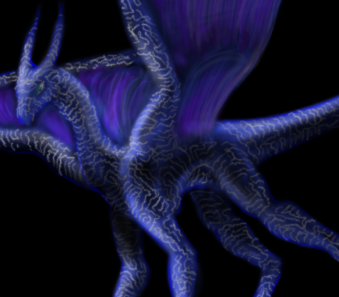
Avishraans are similar to “Western” dragons in overall body plan, possessing two forelimbs, two legs, and two wings. Between twenty and twenty-five feet in length and standing up to ten or twelve feet high, their bodies have a tendency toward slimness, eschewing muscular bulk for a more wiry frame. The main exception to this are in the legs (to provide power for lunging forward) and in the chest (to power the wings for flight). Avishraans are covered in scales that tend to be rather small, smooth, and flat, and that interlock very smoothly with nearby scales. It is very easy for one who has never before encountered the species to mistake this smooth, flexible covering for a thick hide, since the scales are too small to see clearly except at close range.
The limbs of Avishraans are somewhat catlike. The legs are designed so that they are normally bent in two places; around the “knee” and the “heel”, taking them compared to the analogues in a human leg. In this way, an Avishraan can be said to walk on its toes, with the rest of its elongated “foot” raised up off the ground. Each foot has three clawed toes; two rest on the ground, and are wide and padded to help with balance, while the third sits slight higher up the “foot” on the inside, having little mobility and a larger claw. Though not as bulky as in other animals, the leg muscles are relatively powerful, equally useful for pushing upward into flight or pushing forward for a quick lunge-and-sprint.
The forelimbs, unlike in most dragon species, are rather attenuated like the legs, much as one might expect from the front legs of a quadruped; despite this, however, Avishraans do use their hands and arms, and do not always travel on all fours (though they frequently do). Compared to human hands, the bones between the wrist and the knuckles are rather long and slightly splayed out, creating an extra segment of arm that is somewhat broad and flat, and paddle-like. Two fingers and a thumb, all fairly long and thin and all clawed, sit at the very end of this segment (the claws are retractable into little pouches, unlike claws on other limbs).
Avishraan forelimbs are not too well-muscled, designed more for extremely fast attacks and holding small prey, rather than subduing anything large. Because of this, and the arms' awkward length and configuration, Avishraans have difficulty lifting or pulling heavy objects.
The wings are generally batlike in that they are modified versions of the arms, the main difference being that two of the fingers have been greatly lengthened, have lost their claws and have broad, thin membranes connecting them to each other and to the body. The clawed “thumb” that sits atop each wing is largely vestigial, sometimes useful for gripping onto a surface but otherwise ineffective as a means of defense or manipulation.
Extending from the muscular chest is the neck and head. Avishraans vary considerably in the length of their necks; longer necks were more common eons ago, when from shoulders to nose tip an individual could be as long as the main trunk of its body. Nowadays most Avishraans have necks shorter than that, but still often longer and more mobile that in humans (relatively speaking). The neck can connect to the head in the back, from underneath, or from some point in between. Connections from underneath tend to be associated with shorter, more upright necks and skulls with a rounded back (often seen in the Chosen breeds), while connections in the back are more commonly seen with longer, forward-bending necks and long, narrow, flat-topped skulls.
The head of the Avishraan contains the brain and all major non-tactile sensory functions. The shape of the head and exact arrangement of the face are also quite variable between individuals. The muzzle is generally medium or long and tapering; at its end it can be pointed and streamlined, or somewhat bulbous, or blunt-ended. The nostrils sit on top of the muzzle, although they can sometimes be far enough apart as to be almost on the sides; sometimes they are longer and slitted, sometimes rounder (the slitted type is more easily sealed shut underwater), and can be between the front and the middle of the muzzle. The mouth, filled with sharp, conical teeth, runs nearly the entire length of the muzzle, and can open very wide.
Above the base of the muzzle is a slight bulge, consisting of thick bone, behind which lies the brain. On either side of this bulge, on the sides of the head, are the eyes; unlike the eyes of most higher animals, Avishraan eyes are compound, consisting of a multitude of tiny triangular sections, and fixed in place. Resembling globes of crystal (which, in some breeds, are glowing), the eyes can be in a wide variety of colors, and can and will also shift color. The eyes are sometimes protected by outgrowths of the bulge, manifesting as a bony ridge above each eye, but this is rare.
On the edges of the bulge, above each eye, are the Avishraan antennae. These are long, flexible, hollow filaments composed of a series of thin cartilage rings bound together with connective tissue and tiny muscles, and covered with a thin membrane; they are important sensory organs. In the base of each antenna is a lump of nervous tissue, actually an extension of the brain, that is responsible for sending and receiving psionic emanations, both telepathic and telekinetic. This portion of the antenna usually has thicker walls and is still partially embedded in the head, making it more protected from attack.
More toward the main length and the tip of each antenna, back from where the antenna becomes separate from the head, it becomes a more delicate and sensitive structure. The cartilage rings composing the walls of the antenna become thinner and permeated with tiny air-filled holes and chambers; these, along with the hollow interior of the antenna, are lined with vibration-sensitive cilia connected to a multitude of nerves snaking down toward the basal segments. This arrangement provides the function of hearing for the Avishraan in place of ears; but due to the antennae being exposed and fragile in this region, they are frequently a target for attack, and damage to the antenna is invariably painful and debilitating.
Lastly, the Avishraan tail tends to be rather long, usually with a fair amount of thickness to it, though it can also be thin and whiplike toward the end.
Natural Variation

Aside from the minor differences already mentioned, and the ones to be mentioned further on, there are others that require mention.
Avishraans store fat somewhat differently than humans do. Although some fat is stored around the front-waist area, much of it is stored in the tail, especially near the base. This is partially for hydrodynamic reasons, partially to serve as a counterweight to the body trunk in maintaining posture. An overweight Avishraan will eventually store some fat in the thighs and upper arms, but will more noticeably have a bulging waist and a puffy tail.
The visual differences between a male Avishraan and a female Avishraan, while obvious enough to a member of the species, are not necessarily obvious to a human being, whose instincts are not keyed to notice the various defining features.
Avishraan males are typically larger and (slightly) more muscular, especially in the chest. Their antennae tend to be long and straight, and more prominently segmented than a female's; their heads tend to be broader in the vertical dimension. For hydrodynamic reasons, male genitalia are usually not visible, concealed within a small pouch on the underside, near the base of the tail. Avishraan females, however, tend to be shorter, more compact, and a bit less distinctively lithe. Though not as muscular as males, they do have stronger legs, and can sprint very quickly over short distances. The antennae are often more curled than on a male, sometimes even to the point of being coiled. For reasons related to childbearing, they tend to have broader hips and tails that are thicker near the base.
Avishraans come in a wide variety of colors, but each individual will usually have scales of only one color (or varying shades of one color). An individual with a mark of a different color (or colors) on its body would be considered rare and exotic, and quite possibly attractive, although if one is so colorful as to be without a primary color, this may be considered TOO exotic. In the most common breed, color is a mark of clan membership (dragons having the same primary color are more likely to be related), and as a result Avishraans of different colors will often find each other objects of hate at fight sight. Interclan relations are very poor, and warfare and bigotry are widespread on Avishraa.
The original two breeds of the Chosen Ones (the Davir Sria and Davir Kaea) have, aside from smaller, thinner, and overall sicklier bodies, also tend to have black, burnlike marks or growths. If there is anything an Avishraan reviles at first sight more than someone of another clan or someone of a different species, it is a Chosen; non-Chosen who happen to have similar-looking patches of black scales are also frequently targeted. The third Chosen breed, the Hzataalar Kaea, look almost exactly like normal Avishraans, and so are frequently overlooked.
When an Avishraan becomes elderly, it tends to become slightly lighter-colored, thinner, and more bony, and to be bent over slightly more. It also tends to develop wrinkles around the eyes and loose folds on its throat and beneath its muzzle. The scales near the tip of the muzzle tend to become brittle and fuse together into larger plates, forming distinctive ridged structures; some individuals also develop these on top of the head and down the back of the neck. (In males only, the ridges tend to lose their color, going silvery, gray, or white.)
Senses and Behaviors
The normal standing position of an Avishraan involves balancing on two legs, on the toes of the feet. The trunk of the body is angled forward, with the hips as the pivot; due to the structure of the spine and hips, and the muscularity of the chest, Avishraans find it very difficult to stand very upright for any length of time. The weight in the front of the body is prevented from falling forward by tension in the spine, and by the counterweight of the tail; however, this causes stress on the back, especially as one ages. It is far more comfortable to sit down (which is done in the manner of a cat or dog, hindquarters resting on the ground, front supported by the forelimbs) or to lie down (normally on the belly or side, limbs folded up).
Avishraans keep their wings folded next to the back when not in use. When preparing to travel by swimming, an Avishraan will crouch down, use its powerful legs to push forward into the water at speed, and extend its wings after it is under the surface. The wings serve as large flippers, capable of pushing the dragon along, while the paddlelike arms provide steering and some extra thrust. Descended from water-dwellers, an Avishraan can hold its breath for a long time, up to an hour if it fills its lungs beforehand. This ability to survive on reduced amounts of oxygen is also useful in flight; Avishraan flight behaviors are mostly modifications of the older swimming behaviors.
Avishraan combat behaviors, at least when driven by instinct, tend to be fairly simple, based around the ideal of a quick strike. Whether hunting, or attacking a predator, or defending a nest, Avishraans tend to hunker down, crouching low and winding up their legs for a sudden lunge forward. When after prey, the usual tactic is to do this while simultaneously snapping forward their forelimbs to spear or grab the prey animal (usually fish, or else small ground-dwelling mammals and birds). When attacking a more equal foe, it may use its forelimbs either in a slashing attack or to propel itself forward with extra force (leaving only its teeth for an attack). When doing this, it will typically aim for the underside, either going for the throat (if low enough), the underbelly, or the legs. In a more defensive posture, the crouch will not be so low, and the wings will be extended (either to make the dragon appear larger, or to shield others from view), and instead of a full forward movement, it will bounce forward, attack, then bounce back to its defensive position.
(The main exception to this battle style usually occurs when two males are fighting over a female; instead of quick strikes over a distance, the combatants will often enter heavy, slow, toe-to-toe combat. Though they are less suited to such a method, it is more impressive to potential mates… or so they suppose.)
Because of their peculiar construction, the Avishraan senses often present unique challenges.
Avishraan eyes are fixed in either side of the head; they cannot turn in their sockets. Because of their compound nature, they see very well in panorama, and can detect motion very well; but because of their position their fields of vision do not overlap, they have poor depth perception, and they cannot easily see what is directly in front of their faces. Because of these factors, they must each turn their entire head to get a better view of things. When an Avishraan is alert and trying to pay attention to something, it will often weave its head back and forth, getting views of it through one eye then the other.
Eye color is indicative of emotion, although the exact correspondence between color and mood depends on the personality and/or the Orderly or Chaotic alignment of the individual. As far as anyone can tell, this color shift does not affect vision in the least.
The antennae also have odd characteristics. Typically held somewhat erect by the tiny chains of muscles lining them, the antennae will lower when an individual is downcast or inattentive; one or both may be stiffened to rigidity if an individual is especially alert or anxious.
Aside from the problem of fragility mentioned earlier, the antennae are also problematic in that the sense of hearing they provide is not particularly excellent in most normal situations. At best, an Avishraan would be able to match a human being in hearing acuity. This is because the antennae are adapted to receiving frequencies through the medium of water; that is, while swimming. Sounds travel farther underwater, and have different properties than when traveling through air.
The Avishraan sense of smell is also quite weak; although sensitive to certain types of identification and mating pheromones, it is otherwise little used. More powerful is the sense of taste (though it is very closely connected to the sense of smell); when eating or otherwise tasting something, they are capable of detecting very fine nuances of flavor. Because of this, they prefer foods with simple, strong smells (like fish) but complex, varying, or subtle flavors (also like fish).
The Avishraan voice is produced in a manner similar to that in humans. However, their voice boxes have a complicated internal structure, which allows them to make a variety of strange noises. Among the most used of these is the click sequence; like dolphins, Avishraans can emit series of brief clicks of varying frequencies from their throats. These are often used in the expression of emotion; a warning or angry tone can involve a “rumbling” of low-frequency clicks, while a cry of anger can have a trilling squeal of high-frequency clicks imbedded in it (this is the most frequent Avishraan version of a “roar”). Avishraans that are having difficulty controlling their speech (whether from injury, emotional state, or drunkenness) will frequently produce a “hissing” noise, not merely from the actual hissing of their “s”es, but also from a white-noise, snow-on-the-TV-screen sort of sound emerging from its throat while speaking.
Avishraan psionic senses are common to the entire species; that is to say, it is considered a normal sense to have in any breed, and those few individuals who happen to be born without telepathic abilities tend to be considered badly maimed. Avishraans originally developed their psionic powers for use in hunting, and can distract and misdirect the minds of most nonsentient animals quite handily. However, Avishraans can also communicate with one another psionically, as well as attempt to take over each others' minds. Unlike the psionics of some other creatures, Avishraan mindsight is directional; that is, an Avishraan cannot “see” in all directions at once with equal clarity, but must focus on one (or, in skilled individuals, several) particular targets. Although mindsight can be used to look in any physical direction, and is not limited by which way the head is turned, it is limited by the attention an individual must devote to what it is “seeing”. Therefore, all that the individual is NOT focused on becomes an area of peripheral vision: not entirely unseen, but perceived only dimly until the focus of scrutiny shifts.
Life Cycle
The baseline members of the Avishraan species, from which the Srians and Kaeans were derived (these groups will be covered later on, insofar as they differ from the normals), consist of over a dozen clans defined mostly by scale color. These clans bear a deep revulsion toward each other (and, in fact, everyone else), and gene mixing is considered a taboo. As a result of this isolation, the lengths of their respective life phases are slightly different; although this is considered an important part of clan identity, the fact of the matter is that the divergences are so slight as to be not worth noting in the following list.
Pregnancy (5 months)
The ancestors of the Avishraans had shorter pregnancies than they do today. Eggs were laid only after two or three months, and embryos spent a longer time developing outside the mother's body. The past twenty thousand years, however, have seen a slow shift toward longer pregnancies and shorter incubations. Clutches consists of between three and five eggs at a time.
Incubation (2 months)
During this time, the parents sit on the eggs to keep them warm (the mother more typically does this, but the father may also participate). When both parents are away, the eggs are generally left buried in warm sand, or floating in heated water.
Childhood (0 - 65 yrs)
Dragonlets are typically self-sufficient, in a relative sense; although they need to be taught many things and provided with food, they do not require intensive care, and quickly learn enough sense to safely explore and wander on their own. Psionic powers are typically only somewhat developed by the end of this stage, but are usually adequate to provide a defense against other creatures.
Adolescence (65 - 100 yrs)
As opposed to the steady growth of childhood, adolescence involves the onset of growth spurts that, by the end of the stage, brings individuals to their full sizes. At the same time, this growth is accompanied by sexual maturation and associated hormonal imbalances; males become more aggressive and combative, while females become more moody and territorial. Although adolescents are capable, in their later years, of producing offspring, there are strong cultural inhibitions about permitting sexual behavior before 100 years of age; in addition, children of adolescents have a higher occurrence of developmental problems.
Wanderlust (100 - 250 yrs)
At the onset of wanderlust, individuals attain their adult size and are sexually mature. Their behavioral patterns, however, remain strongly different from that which shall prevail later in life.
Wanderers exhibit powerful urges for travel, although the manner differs between sexes. Females will often maintain a semipermanent base, either among kin or in some other location with a source of supplies and secure from intrusion, returning to it between journeys and using it to rest and resupply. Males are more likely to forsake any sort of attachment to a location, and to wander nomadically. Both sexes will, while traveling, either live off what they can find or carry, or else trade for supplies with other wanderers. This wanderlust is believed to derive from ancient migratory behaviors by the Avishraan's aquatic ancestors.
This lack of attachment also extends to personal relationships. Wanderers have fairly strong sexual appetites, and will tryst frequently with any willing partners they come across; but their migratory habits usually prevent the formation of close, long-term relationships, though individuals may have affection for favored partners.
Wanderers are fully capable of producing children. Starting at about 100 years of age, females have a period of high fertility each 50 years or so, during which the likelihood of producing offspring is highest. However, female wanderers, not yet desiring the responsibility of caring for children, will usually try to avoid mating during their fertile times; those who do have children will usually give them into the care of relatives until settled enough to take up parenting.
Although individuals will begin to abandon wandering and take up settled lives at about 250 years, this date is not a definitive cut-off. It is common (though not universal) for individuals older than 250 to continue wandering until they find a mate.
Maturity (250 - 1900 yrs)
The longest life stage of the Avishraan normal. Mature adults typically settle down in a permanent home with one mate for the rest of their lives (although, if one's mate dies, one will often try to find another). As during wanderlust, mature females typically experience fertile periods once every fifty years. Unlike wanderers, however, mature adults are more psychologically suited to family life, and indeed will usually try as often as possible to produce offspring (this may be largely due to societal pressure, however; feuding between clans exacts a high toll on the population).
Mature adults also have a fuller role in their societies, and unlike the wanderers, are capable of gaining considerable status. This usually comes from a combination of seniority, “service to the clan” (an concept which embraces many possible actions, such as prowess in battle, producing many offspring, discovering some sort of useful information, aiding the maintenance of clan infrastructure, and others), and wealth. Wealth is, in itself, often a byproduct of the clan wars, gained either directly in battle by looting, or indirectly by selling valuable resources to clan warriors.
Old Age (1900 - 2100 yrs)
Normals are generally able to retain good health and appearance, and to produce children, until the age of 1900 years. At this point begins a relatively rapid decline in physical health and vitality, eventually culminating in death. Although this usually occurs around the age of 2100, the actual time of death can be influenced my many factors; at least one normal is known to have lived to 2600.
The high mortality rate as a result of war means that few individuals actually reach old age; those who do, especially if they were warriors in their earlier lives, are greatly revered for their experience (most manage to maintain their mental vigor up until the very last years of their lives). Although most are well cared for and are no longer obligated to serve the clan, elders frequently allow themselves to be consulted by the clan rulers on certain issues.
Society and Civilization
The majority of Avishraans maintain a remarkably consistent worldview and structure of society, despite their many divisions; they are far more homogeneous than any comparable human culture.
Avishraan normals are mostly organized into clans that, although based nominally on lineage, are in reality defined more by the primary scale color. There are between ten and twelve major clans, as well as a smaller number of minor clans, all of which compete fiercely for territory and resources. Each clan is itself organized into a series of castes whose membership is determined by a combination of birth, age, wealth, and merit. Movement between the castes is far from unknown, but upward mobility generally requires lengthy or important service to the clan, and is the cause of many duels over status. In increasing order of prestige, the four largest castes are Suppliers (hunters, merchants, medics), Fighters (career front-line warriors), Leaders (military or political powers) and Elders (older members of the community, advisors and moral authorities).
This general structure is due in large part to the powerful adversarial instincts of mature Avishraans. The people of the clans have a very strict worldview separating their surroundings into dualities: “us” vs. “them”, “me” vs. “everyone else”, “good” vs. “evil”. The way an Avishraan sees the world, then, comes of a combination of fierce individualism, intense clan loyalty, and unshaken belief in one's own moral superiority. Most Avishraans see their own personal wants as being identical to the good of their clan, and the good of the clan as identical to the reason for existence; all else is irrelevant or even evil.
Within one's own clan, an Avishraan will seek to climb higher and crush others lower, so that it can (so it believes) better use its superior talents for the good of the whole. Yet all Avishraans of one clan, no matter their differences, will agree that the other clans are abominable, hated enemies, fit only to be crushed or even exterminated, and that their own clan is the best and most civilized. Members of other species, if they are ever encountered, are even less liked, and are considered animals.
Each clan maintains a territory for its exclusive use, and constantly seeks to expand into the territories of the other clans. While the minor clans do this from the hidden depths of the jungle, relying more on stealth, the major clans center their territories around the gorge of the Sah'varr River, where the mighty waters have carved a canyon through the rock. Here, in the cliffs towering above the river, each clan has carved spectacular fortresses, city-warrens excavated from the very stone.
But mixed in with this siege mentality and virulent xenophobia is a strange sense of honor. There are often elaborate rules for the fighting of battles and the treatment and ransoming of prisoners. Perhaps a remnant of some sense of racial unity between them, these rules prohibit the mistreatment of people of other clans captured in combat, dictating that they be fed and housed reasonably during their imprisonment. Prisoners are typically kept until the enemy clans agree to terms of ransom, in which prisoners are returned safely in exchange for payment in treasure or supplies. Still, “mistreatment” can be a relative term; it is not terribly uncommon, or particularly looked-down upon, for male warriors to keep captured females for their own pleasure, although such prizes of war are never considered mates, nor the children that they bear considered legitimate.
All of the above, however, should not be taken as the only side of Avishraan civilization. There is a substantial subculture of Wanderers, young post-adolescents who are in a stage of life in which they seek release from physical and mental bonds, and go wandering from place to place in search of new sights and experiences. Forming temporary camps and brief relationships, Wanderers remain relatively untouched by the prejudices and preoccupations that will afflict them in later life, happily traveling with members of other clans and (when they can) visiting their territories. Older Avishraans are, of course, usually offended at this youthful disregard of tradition and morality; but since they themselves, and all their species, go or had gone through the same stage, finding a solution to the “problem” has proven difficult. Those clans unwise enough to forbid the Wanderers from travelling freely have experienced deep social unrest, civil wars, and mass exoduses of youthful population; there are reports that there is at least one remote clan consisting entirely of former disgruntled Wanderers of many colors.