User Tools

Site Tools


xtauh:start

Differences

This shows you the differences between two versions of the page.

Link to this comparison view

Next revision
Previous revision
xtauh:start [2020/08/13 11:27] – created shyriathxtauh:start [2024/01/25 09:51] (current) shyriath
Line 1: Line 1:
-The species known as the **xtauh** in [[language:imperial|Imperial]] (both singular and plural) are a species of intelligent dragon that might be considered the second-ranking [[species:start#Enenkalar|sapients]] on [[avishraa:|Avishraa]] and the creators of its most advanced civilizations. Though not as numerous, as technologically advanced, or as organized as the [[takma:|takmar]], their environmental flexibility and self-reliance have stood them in good stead.+====== Xtauh ====== 
 +The species known as the **xtauh** in [[language:imperial:start]] (both singular and plural) are a species of intelligent dragon that might be considered the second-ranking [[species:start#Enenkalar|sapients]] on [[universe:mikurmiya:avishraa]] and the creators of its most advanced civilizations. Though not as numerous, as technologically advanced, or as organized as the [[takma:|takmar]], their environmental flexibility and self-reliance have stood them in good stead.
  
 ===== Numerical characteristics ===== ===== Numerical characteristics =====
-  * Lifespan: Up to 19 [[concept:timekeeping|cycles]] (100 Earth years); 11-12 cycles closer to average+  * Lifespan: Up to 19 [[concept:timekeeping#cycle|cycles]] (100 Earth years); 11-12 cycles closer to average
   * Average length: Adult females are an average of 1.9 meters long, nose to tail, with a 4 meter wingspan; adult males are an average of 1.75 meters long, with a wingspan of 3.5 meters   * Average length: Adult females are an average of 1.9 meters long, nose to tail, with a 4 meter wingspan; adult males are an average of 1.75 meters long, with a wingspan of 3.5 meters
   * Average weight: Adult females average 75 kg (65 kg in local gravity); adult males average 48 kg (41 kg in local gravity)   * Average weight: Adult females average 75 kg (65 kg in local gravity); adult males average 48 kg (41 kg in local gravity)
Line 10: Line 11:
 ===== Anatomy and physiology ===== ===== Anatomy and physiology =====
 ==== Shape and features ==== ==== Shape and features ====
-//See also the articles on the [[xtauh:body|xtauh body]] and on [[xtauh:scales-and-coloration|scales and coloration]].//+//See also the articles on the [[xtauh:body|xtauh body]] and on [[xtauh:scales and coloration]].//
  
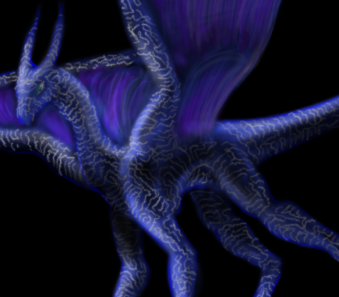
-Xtauh are large [[species:clade:draconiform|draconiform]] [[species:clade:hexapod|hexapods]]. Put another way, they have six limbs; a pair of hindlimbs, used exclusively for walking; a pair of forelimbs, shorter than the hindlimbs, which can be used either for locomotion or for fine manipulation; and a pair of wings, used in either flying or swimming. Each limb has four digits; those on the forepaws form three fingers and an an opposable thumb, those on the hindpaws three toes and a non-vestigial dewclaw, and those on the wing three main spars and a tiny, largely vestigial, thumb. The spars are connected to each other, and to the sides of the body and tail, with a thin web of skin.+Xtauh are large [[species:clade:draconiform]] [[species:clade:hexapod|hexapods]]. Put another way, they have six limbs; a pair of hindlimbs, used exclusively for walking; a pair of forelimbs, shorter than the hindlimbs, which can be used either for locomotion or for fine manipulation; and a pair of wings, used in either flying or swimming. Each limb has four digits; those on the forepaws form three fingers and an an opposable thumb, those on the hindpaws three toes and a non-vestigial dewclaw, and those on the wing three main spars and a tiny, largely vestigial, thumb. The spars are connected to each other, and to the sides of the body and tail, with a thin web of skin.
  
 The head is of a more or less aerodynamic shape with a long muzzle. The teeth are generally conical, although those toward the rear of the mouth have truncated, almost flattened, points. The nostrils can seal while underwater. The eyes have catlike, slitted pupils, and are usually light in color, typically some shade of blue, gray, or washed-out green. Other colors, such as gold, are possible. Xtauh do not have ears, but instead a pair of antennae; long, flexible, backwards-sweeping structures with hollow interiors. The set of the eyes and antennae, and to a lesser extent the mouth, play a major role in xtauh facial expressions.  The head is of a more or less aerodynamic shape with a long muzzle. The teeth are generally conical, although those toward the rear of the mouth have truncated, almost flattened, points. The nostrils can seal while underwater. The eyes have catlike, slitted pupils, and are usually light in color, typically some shade of blue, gray, or washed-out green. Other colors, such as gold, are possible. Xtauh do not have ears, but instead a pair of antennae; long, flexible, backwards-sweeping structures with hollow interiors. The set of the eyes and antennae, and to a lesser extent the mouth, play a major role in xtauh facial expressions. 
  
 ==== Motion and locomotion ==== ==== Motion and locomotion ====
-//See also [[xtauh:body-language|Body language]].//+//See also [[xtauh:Body language]].//
  
 Xtauh are capable of either a bipedal or quadrupedal gait on land. The latter, which involves curling the fingers and placing the weight on the knuckles, is more comfortable for both standing and walking/running for any great length of time, but prevents easy manipulation of tools. The former, meanwhile, frees the forepaws for other activities, but bipedal standing and walking places stress on the lower back and results in somewhat more delicate balance. Most xtauh resort to a bipedal stance only when they need to reach an additional height, or in situations where a balance needs to be struck between motion and manipulation (as with handling weapons in warfare); if manipulation can be accomplished while remaining still, they will simply sit on their hindquarters. Because of their higher center of gravity, males generally find the bipedal stance more difficult to enter and maintain than females do. Xtauh are capable of either a bipedal or quadrupedal gait on land. The latter, which involves curling the fingers and placing the weight on the knuckles, is more comfortable for both standing and walking/running for any great length of time, but prevents easy manipulation of tools. The former, meanwhile, frees the forepaws for other activities, but bipedal standing and walking places stress on the lower back and results in somewhat more delicate balance. Most xtauh resort to a bipedal stance only when they need to reach an additional height, or in situations where a balance needs to be struck between motion and manipulation (as with handling weapons in warfare); if manipulation can be accomplished while remaining still, they will simply sit on their hindquarters. Because of their higher center of gravity, males generally find the bipedal stance more difficult to enter and maintain than females do.
Line 23: Line 24:
 The xtauh neck is only slightly longer, proportionally speaking, than a human neck. It is more flexible, but far more so toward the chest and the sides than toward the back; when quadrupedal, the head can be tilted up, but cannot lift very far above the trunk of the body without experiencing neck pain. Getting a better view may involve lifting off one's forepaws temporarily. The xtauh neck is only slightly longer, proportionally speaking, than a human neck. It is more flexible, but far more so toward the chest and the sides than toward the back; when quadrupedal, the head can be tilted up, but cannot lift very far above the trunk of the body without experiencing neck pain. Getting a better view may involve lifting off one's forepaws temporarily.
  
-Xtauh frequently have trouble reaching their own backs. The neck is not long or flexible enough to twist the mouth around to reach, nor can the forelimbs rotate backward far enough to reach anything but the far upper and lower back. The wing-thumb can be use to clumsily scratch the upper back, but this is frequently not considered satisfying; the tail is prehensile, but has relatively poor motor control. [[xtauh:behaviors#Grooming|Grooming]] by other xtauh, therefore, is often an important part of social bonding.+Xtauh frequently have trouble reaching their own backs. The neck is not long or flexible enough to twist the mouth around to reach, nor can the forelimbs rotate backward far enough to reach anything but the far upper and lower back. The wing-thumb can be use to clumsily scratch the upper back, but this is frequently not considered satisfying; the tail is prehensile, but has relatively poor motor control. [[xtauh:behaviors#grooming|Grooming]] by other xtauh, therefore, is often an important part of social bonding.
  
 In Avishraan gravity, which is slightly over 86% that of Earth's, healthy, fit, adult xtauh are capable of flight; they cannot carry much extra weight with them, though they have somewhat more flexibility in this regard than than takmar. Females' larger size and proportionally smaller wings mean that they tend to be weaker fliers than males, and a pregnant or overweight female is generally unable to safely take to the air. In Avishraan gravity, which is slightly over 86% that of Earth's, healthy, fit, adult xtauh are capable of flight; they cannot carry much extra weight with them, though they have somewhat more flexibility in this regard than than takmar. Females' larger size and proportionally smaller wings mean that they tend to be weaker fliers than males, and a pregnant or overweight female is generally unable to safely take to the air.
  
 ==== Senses and perception ==== ==== Senses and perception ====
-//See also [[xtauh:senses|Senses]].//+//See also [[xtauh:Senses]].//
  
 The xtauh senses are broadly comparable to those of humans, at least to the extent that they would be able to detect many of the same stimuli. That said, their visual and auditory ranges are not identical, and the xtauh sense of small is somewhat poorer. The xtauh senses are broadly comparable to those of humans, at least to the extent that they would be able to detect many of the same stimuli. That said, their visual and auditory ranges are not identical, and the xtauh sense of small is somewhat poorer.
  
-Xtauh also have a sense that is absent in humans: the ability to directly perceive emotions and feelings from other beings, referred to as the empathic sense. This is not unique to xtauh among Avishraan species; several related species possess it, and [[concept:empathic-sense|different manifestations of the same sense]] have arisen independently many times throughout the evolutionary history of the world.+Xtauh also have a sense that is absent in humans: the ability to directly perceive emotions and feelings from other beings, referred to as the empathic sense. This is not unique to xtauh among Avishraan species; several related species possess it, and [[concept:empathic_sense|different manifestations of the same sense]] have arisen independently many times throughout the evolutionary history of the world.
  
 ===== Taxonomy and evolution ===== ===== Taxonomy and evolution =====
 ==== Ancestry and relatives ==== ==== Ancestry and relatives ====
-The closest living relatives of the xtauh are a species referred to in [[avishraa:place:brightness|Brightness]] [[language:imperial|Imperial]] as the [[takma:|takmar]], from whom they began to diverge some eighteen thousand cycles ago. Though neither of them recognize the relationship, they remain genetically compatible enough that interbreeding is occasionally possible, though extremely risky. These two species are together classified as the [[species:clade:takmin|takmins]].+The closest living relatives of the xtauh are a species referred to in [[geography:sekhaa:region:brightness]] [[language:imperial:start|Imperial]] as the [[takma:|takmar]], from whom they began to diverge some eighteen thousand cycles ago. Though neither of them recognize the relationship, they remain genetically compatible enough that interbreeding is occasionally possible, though extremely risky. These two species are together classified as the [[species:clade:takmin|takmins]].
  
-The ancestors of the takmins diverged some 74 thousand cycles ago from those of the [[species:clade:dvidalin|dvidalins]], a mostly bipedal clade. The third known sapient species, the [[orghysh:|orghysh]], are dvidalins, though there are also a number of non-sapient dvidalins scattered throughout [[avishraa:place:sekhaa|Sekhaa]]; few of these live in territories inhabited by the xtauh.+The ancestors of the takmins diverged some 74 thousand cycles ago from those of the [[species:clade:dvidalin|dvidalins]], a mostly bipedal clade. The third known sapient species, the [[orghysh:]], are dvidalins, though there are also a number of non-sapient dvidalins scattered throughout [[geography:sekhaa:start]]; few of these live in territories inhabited by the xtauh.
  
 ==== Variations ==== ==== Variations ====
-Xtauh have a much higher variability in skin color than humans do, even within the same population, and it is relatively common for children to be a different color from either parent (see [[xtauh:scales-and-coloration|Scales and coloration]] for details). The physical races that make up the xtauh species, therefore, tend to be defined based on other factors, though some colors are more common for some than for others.+Xtauh have a much higher variability in skin color than humans do, even within the same population, and it is relatively common for children to be a different color from either parent (see [[xtauh:Scales and coloration]] for details). The physical races that make up the xtauh species, therefore, tend to be defined based on other factors, though some colors are more common for some than for others.
  
-There are, broadly speaking, three major racial types.+There are, broadly speaking, four known major racial types.
  
-  * //Wasteland:// Short, rangy and long-muzzled with slightly oversized wings. They tend toward higher proportions of browns and yellows, with some oranges and reds and very few whites. They tend to predominate in the marginal lands of the southern and central [[avishraa:place:brightness|Brightness]]; because the southern edge of this range overlaps with takma colonies in the river valleys, most xtauh encountered by the takmar are of the wasteland type. +  * //Wasteland:// Short, rangy and long-muzzled with slightly oversized wings. They tend toward higher proportions of browns and yellows, with some oranges and reds and very few whites. They tend to predominate in the marginal lands of the southern and central [[geography:sekhaa:region:brightness]]; because the southern edge of this range overlaps with takma colonies in the river valleys, most xtauh encountered by the takmar are of the wasteland type. 
-  * //Sunset:// On average, taller and stockier than wasteland xtauh, and with wings more similar in proportion to those of takmar. They tend toward higher proportions of reds, oranges, yellows and whites and fewer browns. They are the predominant race in the northern Brightness and the grasslands beyond it, as well as along the eastern slopes of what the xtauh call the @[Pinnacles of Night](location:24811c1e-8880-456c-8320-81053be5c577)‌. As these areas are the most thickly settled of the xtauh habitats, sunset xtauh make up a majority of the total population.+  * //Sunset:// On average, taller and stockier than wasteland xtauh, and with wings more similar in proportion to those of takmar. They tend toward higher proportions of reds, oranges, yellows and whites and fewer browns. They are the predominant race in the northern Brightness and the grasslands beyond it, as well as along the eastern slopes of what the xtauh call the [[geography:sekhaa:region:Refuge Range]]‌. As these areas are the most thickly settled of the xtauh habitats, sunset xtauh make up a majority of the total population
 +  * //Dunscale:// They have a build stockier than that of the sunset xtauh, but the size and wingspan of the wasteland xtauh, a shorter muzzle than either; the population is mostly browns and oranges, with some reds but very few yellows or whites. They predominate in the far eastern Brightness and the adjacent mountains known as the [[geography:sekhaa:region:Nest of the Sun]]‌; there are rumors that they have also crossed the mountains into the rift valleys and settled there. 
 +  * //Highland:// Like dunscale xtauh, they have a very stocky build and relatively short muzzles, but a size more similar to that of wasteland xtauh and a proportionally short wingspan. They are relatively dark in scale color, with a very high preponderance of browns and reds with few other colors except as accents. Though relatively numerous up until the Imperial era, few highland xtauh remain in the current era, after long attrition due to competition with takmar in the same region.
  
-As with human races, the boundaries between them are not distinct and there are many areas where considerable mixture has occurred. This is especially true with takma settlements in the [[avishraa:place:brightness|Brightness]], whose founding colonists tended to be an even mix of riparian and highland takmar whose descendants are a fairly thorough blend of both. +As with human races, the boundaries between them are not distinct and there are many areas where considerable mixture has occurred.
- +
-There is also a fourth group, whose biological status is somewhat unusual - it is clearly heritable and clearly has physical markers, but since members of the group also inherit racial characteristics independently of this, its identity as a race is debatable. This group is variously called the [[chosen:|Chosen]], or - less charitably - 'witches', and is distinguished from other takmar by far smaller size, far longer lifespan, and by the possession of innate magic. Their specific traits are addressed in their article.+
  
 ===== Biology ===== ===== Biology =====
 ==== Genetics and reproduction ==== ==== Genetics and reproduction ====
-//See also [[takma:reproduction|Reproduction]].//+//See also [[xtauh:Reproduction]].//
  
-In terms of sexual behavior, neither males nor females are much inclined toward monogamy. Socially, however, most takma societies are [[https://en.wikipedia.org/wiki/Polyandry_in_nature#Paternity_sharing|polyandrous]], with a female having one or more mates who care for her children.+In terms of sexual behavior, neither males nor females are much inclined toward monogamy. Socially, however, most xtauh societies are [[https://en.wikipedia.org/wiki/Polyandry_in_nature#Paternity_sharing|polyandrous]], with a female having one or more mates who care for her children.
  
 The female is able to exercise considerable control over both the timing and the choice of sperm used in conception; while she personally knows who fathered a given clutch of eggs, there are few perceptible indicators to anyone else. Even physical resemblance to the biological father may be obscured, since the way that colors and color patterns are inherited makes it possible for a child to have a color different from either parent. The female is able to exercise considerable control over both the timing and the choice of sperm used in conception; while she personally knows who fathered a given clutch of eggs, there are few perceptible indicators to anyone else. Even physical resemblance to the biological father may be obscured, since the way that colors and color patterns are inherited makes it possible for a child to have a color different from either parent.
Line 65: Line 66:
  
 ==== Life expectancy ==== ==== Life expectancy ====
-takma is considered extremely lucky to live to half a hexatrigesimal - 18 cycles (97 Earth years). While this is certainly possible with a good diet and medical care, it should be noted that most takmar do not get much of the latter and many of them get neither, and so it is no surprise that a more reasonable life expectancy is more like 11 or 12 cycles (60-65 years) even for the fortunate. The main exception to this is the case of the [[chosen:|Chosen]], who are both more naturally long-lived and often have access to magical healing from [[chosen:magic:life|lifegivers]] (see [[chosen:magic:|Magic]]).+xtauh is considered extremely lucky to live to half a hexatrigesimal - 18 cycles (97 Earth years). While this is certainly possible with a good diet and medical care, it should be noted that most xtauh do not get much of the latter and many of them get neither, and so it is no surprise that a more reasonable life expectancy is more like 11 or 12 cycles (60-65 years) even for the fortunate.
  
 Life expectancy generally increases or decreases with prosperity, although the relationship is somewhat less linear to status and gender; middle-ranking females almost always live longer than males of the same class, but both lower- and higher-ranking females tend to live only as long, or slightly less than, males of the same status. This is related to reproductive and social stress at both ends of the spectrum: lower-status females have to cope with the demands of superiors and must often care for families in situations with little spare food and no medical care; higher-status females must strive to prevent their relative status from sinking below that of rivals, and are under high pressure to bear children. Life expectancy generally increases or decreases with prosperity, although the relationship is somewhat less linear to status and gender; middle-ranking females almost always live longer than males of the same class, but both lower- and higher-ranking females tend to live only as long, or slightly less than, males of the same status. This is related to reproductive and social stress at both ends of the spectrum: lower-status females have to cope with the demands of superiors and must often care for families in situations with little spare food and no medical care; higher-status females must strive to prevent their relative status from sinking below that of rivals, and are under high pressure to bear children.
  
 ==== Cyclicity ==== ==== Cyclicity ====
-Takmar have the ability to engage in [[https://en.wikipedia.org/wiki/Unihemispheric_slow-wave_sleep|unihemispheric sleep]]: the ability of one half of the brain to be asleep while the other is awake. While in this state, takmar are able to watch and perceive their surroundings, to fly, to walk across easy terrain requiring minimal steering or care, to do repetitive tasks requiring little or no thought, and to engage in very basic communication - limited to psionic exchange of feelings and very simple verbal statements. However, they are not capable of solving (even mildly) complex problems, doing work requiring concentration, engaging in detailed conversation, or (in the case of [[chosen:|Chosen]]) using innate [[chosen:magic:|magic]]. Should the need to react to a situation arise, they can do so relatively quickly by waking fully.+Xtauh have the ability to engage in [[https://en.wikipedia.org/wiki/Unihemispheric_slow-wave_sleep|unihemispheric sleep]]: the ability of one half of the brain to be asleep while the other is awake. While in this state, takmar are able to watch and perceive their surroundings, to fly, to walk across easy terrain requiring minimal steering or care, to do repetitive tasks requiring little or no thought, and to engage in very basic communication - limited to psionic exchange of feelings and very simple verbal statements. However, they are not capable of solving (even mildly) complex problems, doing work requiring concentration, or engaging in detailed conversation.
  
-Because the equivalent of a full day on Avishraa, the [[concept:timekeeping|turn]], lasts 54.75 Earth days, day and night last for far longer than they do on Earth. No remotely advanced brain can remain fully active for such a length of time; each hemisphere of the brain must be rested regularly, and on average (in adults) strongly adverse symptoms of sleep deprivation occur after approximately 36 hours. Therefore takma sleep/wake patterns do not correspond to the day/night cycle, though this is not to say that their behavior remains constant throughout.+Because the equivalent of a full day on Avishraa, the [[concept:timekeeping|turn]], lasts 54.75 Earth days, day and night last for far longer than they do on Earth. No remotely advanced brain can remain fully active for such a length of time; each hemisphere of the brain must be rested regularly, and on average (in adults) strongly adverse symptoms of sleep deprivation occur after approximately 36 hours. Therefore xtauh sleep/wake patterns do not correspond to the day/night cycle, though this is not to say that their behavior remains constant throughout.
  
-Takmar tend to be most active, and most likely to have both halves of the brain awake, during daylight hours, but also more likely to engage in full-brain sleep. The particular times at which sleep is more likely varies and is determined by poorly-understood factors, but it is natural for different segments of takma societies to fall fully asleep in roughly synchronized "shifts". If daylight activity permits, sufficient use of unihemispherical "naps" may allow an individual to delay full-brain sleep for significant stretches. At night, takmar are more likely to spend time with one half or another of their brain asleep, waking it up as needed to perform more complex tasks. This means that although civilization demands that some things, at least, cannot be put off till daylight, takma societies tend to become more quiet and somewhat less social at night. +Xtauh tend to be most active, and most likely to have both halves of the brain awake, during daylight hours, but also more likely to engage in full-brain sleep. The particular times at which sleep is more likely varies and is determined by poorly-understood factors, but it is natural for different segments of takma societies to fall fully asleep in roughly synchronized "shifts". If daylight activity permits, sufficient use of unihemispherical "naps" may allow an individual to delay full-brain sleep for significant stretches. At night, takmar are more likely to spend time with one half or another of their brain asleep, waking it up as needed to perform more complex tasks. This means that although civilization demands that some things, at least, cannot be put off till daylight, takma societies tend to become more quiet and somewhat less social at night. 
  
 ===== Ecology and habitats ===== ===== Ecology and habitats =====
-Takmar are for the most part restricted to the continent of [[avishraa:place:sekhaa|Sekhaa]]. Despite their affinity for water, they [[takma:behaviors#thalassophobia|fear being on or in water that is too deep or too far from land]], and although some cultures have overcome this to engage in seagoing travel particularly in recent cycles it means, combined with Avishraa's wind patterns, that they have not spread farther from Sekhaa than nearby islands, and have neither visited nor are aware of other continents.+Xtauh are almost entirely restricted to the continent of [[geography:sekhaa:start]]. Although they enjoy being immersed in water and are good swimmers, they [[xtauh:behaviors#thalassophobia|fear being on or in water that is too deep or too far from land]], and have not developed watercraft more advanced than rafts and shore-hugging barges. Their highest population densities are in north-[[geography:sekhaa:start#central_sekhaa|central]] and [[geography:sekhaa:start#northern Sekhaa]]on the grasslands that lie north of the [[geography:sekhaa:region:brightness]], but they can generally be found - either alone or interspersed with takmar - anywhere on the continent between 10° and 60° north, and occasionally further north and south.
  
-Takmar are notbiologically speaking, as adaptable to climate as humans are. They require an overall warmer temperature rangeand are most comfortable around 25 to 35 degrees Cthey also require far more moisture, and need to remain in an environment that has either high humidity or sizable bodies of water available to immerse in. This means that their highest population densities are found amid tropical rainforestsmarshes, and swampsBeing sapient speciestechnology has allowed the range of the species to be extended into colder climes: fire, fur clothes, and well-insulated housing all contribute to survivalThat saidvery few takmar dare to live in climates where it is possible for water to freeze.+The xtauh are environmentally flexible creaturesable to tolerate a wide range of temperatures and climates. Although they do not do as well with low temperatures as humans dothey are much more comfortable in arid climatesunlike the takmarwho die relatively easily away from water and humidity, their bodies conserve moisture relatively easily and their dominance of the deserts of the Brightness is due largely to the fact that the takmar cannot follow them any significant distance from the river valleys. Also unlike takmar, they do not require immersion in water for their health; they will bathe in it if there are sufficient quantities aroundbut in the desert they typically roll in sand or gravel to get clean. 
 +  
 +As resultlow concentrations of nomads and [[https://en.wikipedia.org/wiki/Transhumance|transhumants]] can be found even in the deep desertso long as they are in locations where water is near enough to the surface to reach. Both desert dwellers and those merely traveling across it are typically more active at night; those without significant shelter there survive the day either by moving up to a cooler elevation, or by staying put and aestivating.
  
-As for water itselftakma settlement in arid climates, such as the desert known as the [[takma:place:brightness|Brightness]], clings to rivers and oases; if large amounts of water cannot at least be transported constantly and reliably to a locationthey cannot live there for more than a short time. Therefore, takma settlement depends strongly on either the presence of sufficient quantities of both bathing and drinking water or the ability to accumulate them, which in less rainy environments than they are used to can restrict them to living near riverbanks and shorelines. Traveling between these habitable areas involves either firm control of oases or the establishment and supply of artificial watering holes (or both), usually at significant expense.+Lately, the development of [[concept:glyphic teleportation]] has allowed the colonization of other worldsthough so far this has only been done on an individual basis; no significant xtauh populations have been established off of Avishraa.
  
-Lately, the development of [[concept:glyphic-teleportation|glyphic teleportation]] has allowed the colonization of other worlds, though so far this has only been done on an individual basis; no significant takma populations have been established off of Avishraa.+==== Population ecology ====
  
 ==== Dietary needs and habits ==== ==== Dietary needs and habits ====
-//See also [[takma:diet-and-agriculture|Diet and agriculture]].//+//See also [[xtauh:Diet and agriculture]].//
  
-Takmar have a strong preference for the taste of meat and other savory foods, and they cannot process plant foods with large amounts of cellulose, such as leaves and stems. That said, they are [[https://en.wikipedia.org/wiki/Facultative|facultative]] carnivores, and where meat is not plentiful enough, are capable of subsisting on other kinds of plant foods, such as fruits, tubers, and grains.+Xtauh have a strong preference for the taste of meat and other savory foods, and they cannot process plant foods with large amounts of cellulose, such as leaves and stems. That said, they are [[https://en.wikipedia.org/wiki/Facultative|facultative]] carnivores, and where meat is not plentiful enough, are capable of subsisting on other kinds of plant foods, such as fruits, tubers, and grains.
  
-Having a fairly delicate sense of taste, takmar have been as inventive as humans in the use of herbs, spices, and sauces to flavor their food, either to enhance good flavors or disguise bad ones.+Having a fairly delicate sense of taste, xtauh have been as inventive as humans in the use of herbs, spices, and sauces to flavor their food, either to enhance good flavors or disguise bad ones.
  
 ==== Symbiotic and parasitic organisms ==== ==== Symbiotic and parasitic organisms ====
-Ironically, their empathic ability means that takmar often have a more difficult time bonding with animals than humans do. Their ability has an evolutionary history as a hunting tool rather than as a social one; takmar use it to detect and track prey, while generally shielding their own emotions from each others' empathy.+Ironically, their empathic ability means that xtauh often have a more difficult time bonding with animals than humans do. Their ability has an evolutionary history as a hunting tool rather than as a social one; xtauh use it to detect and track prey, while generally shielding their own emotions from each others' empathy.
  
-Therefore, empathically felt emotions and feelings do not instinctively elicit sympathy - they can even be a nuisance or disruptive - and takmar are more likely to see it as a point of difference from animals than one of similarity, though a few species may be exceptions. Since very young children also have difficulty shielding their emotions, animals with a similar emotional "profile" can be perceived in the same way, though these are relatively few. As a result, takmar generally keep and domesticate animals for food or for work rather than companionship.+Therefore, empathically felt emotions and feelings do not instinctively elicit sympathy - they can even be a nuisance or disruptive - and xtauh are more likely to see it as a point of difference from animals than one of similarity, though a few species may be exceptions. Since very young children also have difficulty shielding their emotions, animals with a similar emotional "profile" can be perceived in the same way, though these are relatively few. As a result, xtauh generally keep and domesticate animals for food or for work rather than companionship.
  
-Work animals are not uncommon, though they are generally small and used in treadmills to power small or simple machines (similar to the [[https://en.wikipedia.org/wiki/Turnspit_dog|turnspit dog]]). Some species can be trained to bear loadsbut there are few species native to the rainforest that are as large as the most popular pack and draft animals on Earth; most species used for this purpose are no bigger than large dogs or Shetland ponies, and can bear or pull only limited loads. For heavy burdens, it is often more economical for takmar to be hitched to a cart and pull it themselves. For similar reasons, as well as their size and shapetakmar do not have riding animals.+Work animals are not uncommon, ranging from small ones capable of powering simple machines (similar to the [[https://en.wikipedia.org/wiki/Turnspit_dog|turnspit dog]]) to large ones capable of bearing or pulling large burdensWhile the anatomy of xtauh does not lend itself well to riding directly upon a mount, carts, chariots, and similar contrivances drawn by animals are widely known (though xtauh often find it preferable for war chariots to be drawn by members of their own kindwho are better able to adapt to the uncertainties of battle).
  
 ===== Behaviors ===== ===== Behaviors =====
-//See also [[takma:behaviors|Behaviors]].//+//See also [[xtauh:Behaviors]].//
  
-While takmar, like humans, have a wide variety of practices based in culture and religion, there are many that rest ultimately in the sociobiology of the species. The possession of the empathic sense, prehistoric territorial instincts and reproductive strategies - factors like these continue to have effects on present-day societies.+While xtauh, like humans, have a wide variety of practices based in culture and religion, there are many that rest ultimately in the sociobiology of the species. The possession of the empathic sense, prehistoric territorial instincts and reproductive strategies - factors like these continue to have effects on present-day societies.
  
 ==== Sociability ==== ==== Sociability ====
Line 108: Line 111:
  
 ==== Courtship ==== ==== Courtship ====
 +Courtship generally involves the male giving gifts to a female with whom he feels there might be mutual interest (the female may have already confirmed this through indirect means, depending on how eager she is to proceed). How a gift is received depends on the female's social and martial status, her personal preferences, and the values of her culture, and the male may take some time to learn the best gifts, assuming he is able to provide them (the female may, if she is quite interested, take pains to 'steer' the male toward the right items). It is understood, however, that as long as the female continues to accept the gifts, she is demonstrating that she is not displeased by the male's attentions. 
 +  
 +After an appropriate amount of time, which is highly variable between cultures, the female will generally "propose" by inviting him to live with her. This may or may not be preceded by a meeting with the female's existing mates, if she has them, to determine how the new male will get along with the other males.
  
 ==== Migration ==== ==== Migration ====
Line 121: Line 126:
  
 ==== Naming conventions ==== ==== Naming conventions ====
-One of the few persistent threads in takma naming traditions is a near-universal preference for names indicating bloodline and lineage - if they exist - being passed down through female descent. Males are usually considered by females to keep their mother's lineage at least until marriage, but those that have left their mother's household frequently adopt an informal additional name indicating affiliation with a band they have joined, or expressing affection for a favorite father, or based on some other personal criterion. Whether their lineage changes upon marriage varies by culture.+One of the few persistent threads in xtauh naming traditions is a near-universal preference for names indicating bloodline and lineage - if they exist - being passed down through female descent. Males are usually considered by females to keep their mother's lineage at least until marriage, but those that have left their mother's household frequently adopt an informal additional name indicating affiliation with a band they have joined, or expressing affection for a favorite father, or based on some other personal criterion. Whether their lineage changes upon marriage varies by culture.
  
 ==== Gender conventions ==== ==== Gender conventions ====
-Across many takma cultures, there is an expectation of females to be strong and assertive, to defend what's theirs, to push ahead, and to not be pushed over - pillars of strength and endurance, doers of deeds. Fertility is also generally an important part of the female image, and someone of childbearing age who either does not or cannot bear children has a diminished status in the eyes of her peers, while having many children is interpreted positively. +Across many xtauh cultures, there is an expectation of females to be strong and assertive, to defend what's theirs, to push ahead, and to not be pushed over - pillars of strength and endurance, doers of deeds. Fertility is also generally an important part of the female image, and one who either does not or cannot bear children has a diminished status in the eyes of her peers, while having many children is interpreted positively. 
- +  
-Males are generally expected to be loyal, obedient to his supervising females, and nurturing toward children. Still frequently, though somewhat less so, is an expectation of resourcefulness in a clever sort of way, a talent for finding creative solutions.+Males are generally expected to be loyal (though not blindly) to their mates, and nurturing toward children. Still frequently, though somewhat less so, is an expectation of resourcefulness in a clever sort of way, a talent for finding creative solutions.
  
 ==== Relationships ==== ==== Relationships ====
 +Females are generally held to have authority over a household, both mates and children. Though there are rare situations where females may "share" a mate, it is far more usual for a female to have one or more males, especially if she is a high-status female in her community. 
 +  
 +The labor required to keep a household running is distributed depending on the size and wealth of the household, but generally the female, and such males as can be spared, go out and catch food or earn income, while at least one male remains at home to perform domestic duties, such as rearing children, home crafts and light repairs, and so on.
  
 ==== Taboos ==== ==== Taboos ====
 +=== Paternity === 
 +Xtauh are by nature inclined to polyandry - the practice of one female having more than one male mate - and, because there are many more males than females, the practice is frequent. But in nearly all xtauh cultures, there is a resistance by females to the idea of identifying, either in private or in public, the paternity of any given child, although their method of reproduction means that the female usually knows it perfectly well. While there are times when the biological father of a child can be identified by observers, it is considered a gross breach of propriety to attempt to have the mother confirm it, or even to mention one's speculations in her presence. It is an even grosser breach of propriety for the female to actually volunteer the information, whether asked or not. 
 +  
 +This taboo is so universal among xtauh societies that it can be classified as a manifestation of the species' evolutionary psychology, especially since it is one shared with the takmar, the species most closely related to the xtauh.
  
 ==== Average technological level ==== ==== Average technological level ====
-While some takma cultures remain at the neolithic levelthe majority of the species resides in areas where somewhat more advancement has taken holdThe most advanced cultures can be roughly compared to the early [[https://en.wikipedia.org/wiki/High_Middle_Ages|High Middle Ages]] in Europe or the late [[https://en.wikipedia.org/wiki/Tang_dynasty|Tang Dynasty]] in China.+Xtauh cultures are not as advanced as those of the takmartechnological progress having been slowed by a number of factors - harsher environments, low population densities, lack of political cooperation or centralizationSave for those who have acquired iron and steel from the takmar, the most advanced xtauh civilizations are at a [[https://en.wikipedia.org/wiki/Bronze_Age|Bronze Age]] level, and many of them remain [[https://en.wikipedia.org/wiki/Neolithic|neolithic]].
  
-The Earthly analogies have begun to break down, however, with the discovery of [[concept:enchantment|enchanting]]. Though still not widely known or trusted among the takmarits overwhelming usefulness is starting to transform the societies it touchesHowever, the xtauh adopted it first and fasterand it remains to be seen whether how this affects their competition with the takmar.+The Earthly analogies have begun to break down, however, with the discovery of [[concept:enchantment|enchanting]]. The xtauh were the first on Avishraa to discover how to enchant itemsand despite some lengthy hiatuses in development due to some [[https://en.wikipedia.org/wiki/Nuclear_fission|unforeseen]] [[history:cloud_era:gate_wars|incidents]], the technique has become increasingly widespread, particularly in the Riverlands north of the Brightness. In some instances, this has allowed them to leapfrog ahead in terms of their abilities.
  
 ===== History ===== ===== History =====
Line 143: Line 153:
  
 ===== Relations with other species ===== ===== Relations with other species =====
-//See also [[takma:relations|Relations]].//+//See also [[xtauh:Relations]].//
  
-The attitude of most takmar toward other sapient species tends to vary between dismissive and genocidal. The most numerous and technologically advanced species on Avishraa, takmar have relatively little reason to feel impressed by either the [[xtauh:|xtauh]] or the [[orghysh:|orghysh]], and are inclined to push them out of land that they feel could be put to better use.+The xtauh having little to no contact with the [[orghysh:]], they are mostly concerned with the activities of their near cousins, the [[takma:|takmar]]. The shared history of the two species hasfor the past few ages, been fairly poor, as the takmar continue to expand into those parts of the xtauh lands that they have habitable.
  
-  * takma:behaviors#Aestivation +  * xtauh:behaviors#aestivation 
-  * takma:behaviors#Apaternalism +  * xtauh:behaviors#apaternalism 
-  * takma:behaviors#Courtship +  * xtauh:behaviors#courtship 
-  * takma:behaviors#Empathic shielding +  * xtauh:behaviors#empathic_shielding 
-  * takma:behaviors#Grooming +  * xtauh:behaviors#grooming 
-  * takma:behaviors#Half-sleep +  * xtauh:behaviors#halfsleep 
-  * takma:behaviors#Male bands +  * xtauh:behaviors#male_bands 
-  * takma:behaviors#Social status +  * xtauh:behaviors#social_status 
-  * takma:behaviors#Territoriality +  * xtauh:behaviors#territoriality 
-  * takma:behaviors#Thalassophobia +  * xtauh:behaviors#thalassophobia
-  * takma:body#Face +
-  * takma:body#Olenor +
-  * takma:body#Sexual dimorphism +
-  * takma:body#Tail +
-  * takma:body#Wings +
-  * takma:senses#Auditory +
-  * takma:senses#Empathic +
-  * takma:senses#Olfactory +
-  * takma:senses#Visual+
  
 {{tag>wip}} {{tag>wip}}
xtauh/start.1597332478.txt.gz · Last modified: (external edit)